Choosing the right DXP means matching a platform to your specific business goals, technical capacity, and growth plans rather than picking the vendor with the longest feature list. The decision mainly comes down to two things: whether a composable or an all-in-one architecture fits your team's capacity to manage integrations, and whether the platform's core strengths content management, personalization, commerce, or analytics actually map to what your business needs most. Getting this wrong is expensive. Analysts at Gartner have found that 85 percent of the effort and cost in a DXP program goes into integration work, not the platform's own built-in capabilities.
In this guide, we will cover:
Most DXP selection processes go wrong in predictable ways, not because the market lacks good platforms, but because the evaluation itself is built around the wrong questions:
None of these problems are unique to any one vendor or platform category. They come from treating DXP selection as a shopping exercise rather than a structured evaluation against real, documented requirements.
Aligning a DXP with business objectives requires a clear definition of what you aim to achieve before evaluating any software. Whether the priority is improving personalization, streamlining content operations, or unifying multiple digital touchpoints, that priority should narrow the field before a single vendor demo happens.
A DXP acts as the central nervous system for digital operations, so how well it connects to your existing CRM, ERP, and marketing tools matters as much as its own built-in features. An API-first architecture that connects cleanly with the systems you already run is often more valuable than a platform with more native features but a closed, harder-to-extend architecture.
Most modern DXPs advertise AI-driven personalization, but the useful question is whether that personalization works with the customer data you actually have today, not the data you hope to collect eventually. A platform that personalizes well with your current CRM and analytics setup is worth more than one with theoretically stronger AI that needs data you have not yet built.
Scalability needs to be evaluated against your actual growth plans, including new markets, new channels, or higher traffic, not just your current size. A platform that fits today but requires a full replatform in three years is a more expensive choice than it first appears once that replacement cost is factored in.
Here is what a typical, feature-driven DXP evaluation looks like.
The team gathers a long list of DXP features from vendor websites and analyst reports, without first ranking which ones actually matter for the business.
Platforms are scored on how many boxes they check, regardless of whether a given feature would ever be used or whether it duplicates something the business already owns.
The platform with the longest feature list wins, often without a hands-on trial confirming those features actually work well for the specific use case at hand.
Once implementation starts, the real cost of connecting the new platform to existing systems becomes clear, frequently exceeding what was budgeted at the start.
Here is the same decision, run against defined requirements instead of a feature list.
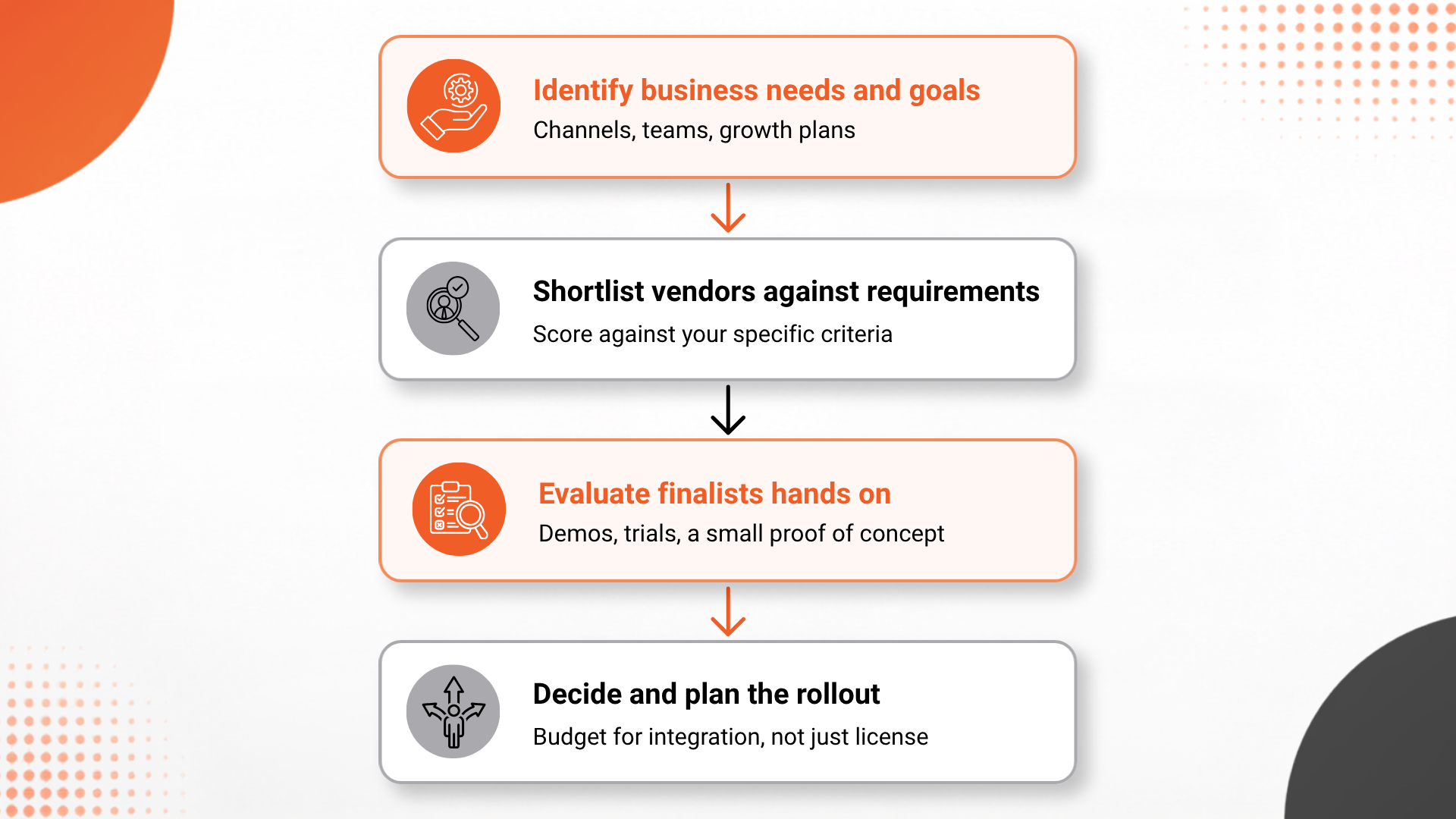
Stakeholders across marketing, IT, and customer service document what the platform actually needs to accomplish, including channels, team size, and growth plans over the next few years.
Vendors are scored against the documented requirements rather than a generic feature list, narrowing the field to platforms that fit the specific use case.
Demos and trials confirm whether the platform meets expectations in practice, and a small proof of concept surfaces integration issues before a contract is signed.
The final decision accounts for integration and customization costs alongside the license fee, since implementation costs commonly double or triple that initial figure.
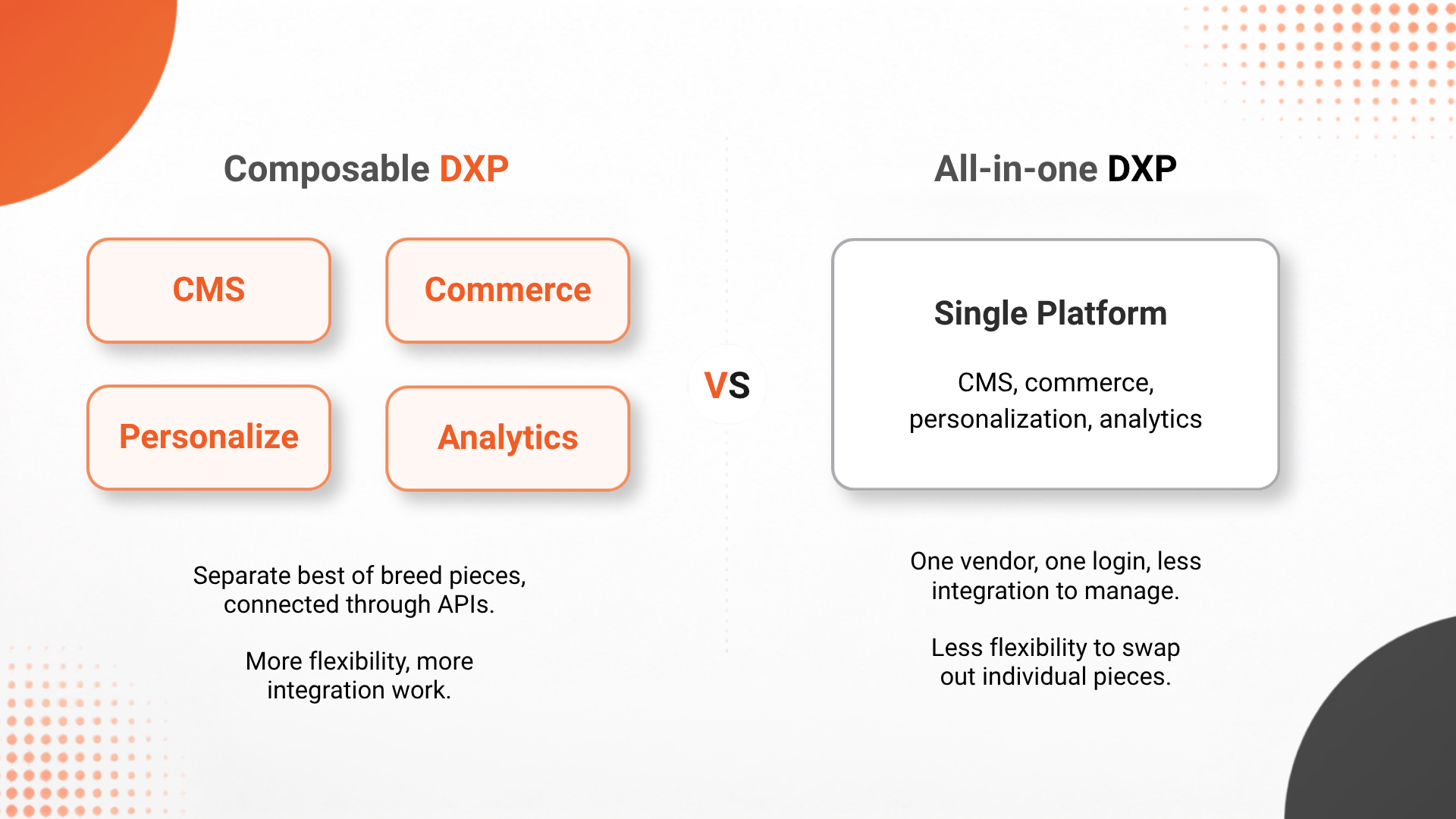
Worth calling out specifically: choosing a composable DXP is often framed as the more flexible option, and it is, but flexibility comes with a coordination cost. A composable stack assembles a CMS, a customer data platform, personalization tools, and analytics from potentially different vendors, which means your team, or your implementation partner, is responsible for the integration work an all-in-one platform would have handled internally. This is not a reason to avoid composable architecture. It is a reason to budget realistically for the technical resources it requires before committing to it. Our own comparison of DXP versus CMS goes further into where that line sits for different business sizes.
| Aspect | Composable DXP | All-in-One DXP |
|---|---|---|
| Architecture | Best of breed tools connected by APIs | Integrated capabilities in one platform |
| Flexibility | High, individual pieces can be swapped | Lower, tied to one vendor's roadmap |
| Integration effort | Higher, managed across multiple vendors | Lower, mostly handled internally |
| Internal technical capacity needed | Significant | Moderate |
| Best fit | Larger organizations with technical resources | Small to mid-sized businesses wanting simplicity |
| Vendor relationships | Multiple | Typically one primary vendor |
Structured Evaluation Reduces Costly Mismatches. Businesses that document requirements before comparing vendors consistently avoid the common trap of choosing a platform that looks impressive in a demo but does not fit their actual operating model.
Composable Architecture Is Becoming More Accessible. Gartner projects that at least 70 percent of organizations will be mandated to acquire composable DXP technology by 2026, up from 50 percent in 2023, reflecting how much easier it has become to assemble a composable stack compared to a few years ago.
Hands-On Trials Catch Problems Early. Requesting demos or trials before committing consistently surfaces integration or usability issues that would otherwise only appear after a contract is signed.
Existing DXP Investments Are Getting Smarter. Platforms already in use are adding AI-driven personalization and content tooling that reduce how much custom development a business needs to layer on top.
Composable Flexibility Has a Real Coordination Cost. Every additional best-of-breed tool in a composable stack is one more vendor relationship, one more integration to maintain, and one more point of potential failure during an upgrade.
All-in-One Platforms Trade Flexibility for Simplicity. Consolidating into one vendor reduces integration work, but it also means being more dependent on that vendor's own roadmap and pricing decisions going forward.
The License Fee Is Rarely the Real Cost. Implementation costs commonly double or triple the license fee once integration, data migration, and customization are included, which makes budgeting on license price alone unreliable.
AI Features Need Real Data to Deliver Value. A platform's personalization and AI capabilities are only as useful as the content and customer data actually feeding them, so a DXP evaluation should include an honest look at your current data quality, not just the vendor's AI roadmap.
Composable Is Increasingly the Default, Not the Exception. Gartner's own projection that most organizations will be required to adopt composable DXP technology by 2026 suggests the market is shifting away from monolithic platforms faster than many buyers expect.
A DXP Choice Can Fail Without a Content Strategy. Analysts warn that a meaningful share of organizations will fail to deliver effective digital experiences specifically due to a lack of AI-driven content coordination and operations strategy, not due to any shortcoming in the platform itself.
Some Businesses Do Not Need a Full DXP at All. A small business or startup running a single marketing website, without a need for advanced personalization or multi-channel delivery, is often better served by a simpler CMS than by a full DXP, regardless of how attractively priced the DXP's entry tier might be.
Choosing the right DXP is less about finding the platform with the most features and more about matching a platform's architecture and strengths to your organization's actual operating model. A composable stack rewards businesses with the technical capacity to manage multiple integrations. An all-in-one platform rewards businesses that want less to manage internally, even if that means slightly less flexibility down the line.
Neither choice is inherently better. The businesses that end up satisfied with their DXP are the ones that defined their requirements clearly, tested platforms hands on rather than relying on demos alone, and budgeted for the real cost of implementation rather than just the license fee.
If your organization is starting this evaluation, writing down what you actually need the platform to do, in plain language, before contacting a single vendor is still the most reliable starting point available.
A DXP, or digital experience platform, is a broader suite that combines content management with personalization, marketing automation, analytics, and often commerce. A CMS focuses mainly on creating and managing web content, while a DXP is built to manage the full customer experience across multiple channels.
Most small businesses are better served by an all-in-one DXP, since it requires less integration work and a smaller internal team to run. Composable DXPs suit larger organizations that already have the technical resources to manage multiple connected systems and need the flexibility to swap out individual components.
Implementation costs often double or triple the license fee once integration, data migration, and customization work are included. Analysts have found that a large share of total DXP program effort and cost goes into integrating the platform with existing internal and external systems, not the platform's built-in features.
The criteria that matter most are alignment with actual business goals, integration capability with existing CRM and ERP systems, personalization and AI features, scalability as the business grows, data security and compliance support, ease of use for internal teams, and the quality of vendor support.
A structured DXP selection process, from identifying requirements to signing a contract, typically takes two to four months for a mid-sized organization, though it can extend longer for enterprises that need extensive stakeholder alignment and a formal RFP process.

With more than a decade of experience in designing and developing enterprise-grade applications, Manoj brings deep technical expertise and a solution-driven approach to software development. Specializing in modern technologies, cloud-native architectures, AI-powered applications, and system integrations, Manoj leads development teams in delivering secure, scalable, and business-focused solutions. Committed to engineering excellence and innovation, Manoj enjoys solving complex technical challenges while helping organizations accelerate their digital transformation journey.
Follow on LinkedIn

.png)
_2.png)
_1.png)