We have officially moved past the era of the single, omnipotent chatbot. Asking one Large Language Model (LLM) to research competitors, write code, run quality assurance, and publish a report is like asking a chef to simultaneously cook, wait tables, and balance the restaurant's accounting books. It simply does not scale.
Welcome to the era of agentic AI. To achieve true enterprise automation, industry leaders are deploying specialized "digital workers" that collaborate to solve complex, multi-step problems. This paradigm shift relies entirely on building robust multi agent systems.
A single AI model has a finite context window and bounded reasoning capabilities. When presented with a massive, ambiguous enterprise task, a solitary LLM will lose focus, hallucinate, or become trapped in an execution loop. This operational bottleneck is solved by dividing and conquering through AI orchestration.
Instead of relying on a monolithic model, modern engineering leverages multi agent AI—a structure where specialized AI agents communicate, delegate, and review each other's work.
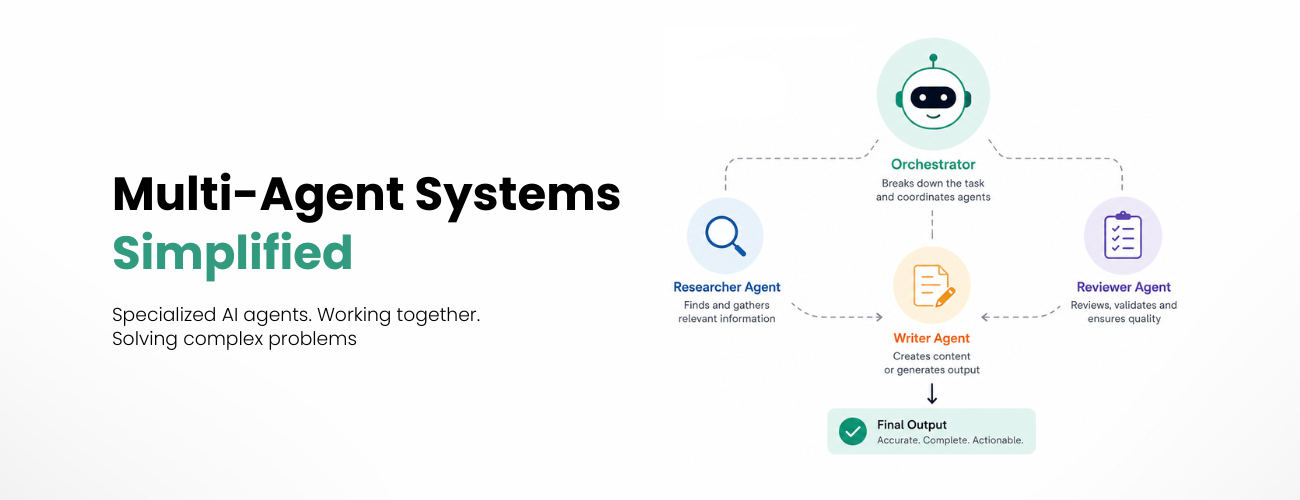
A multi agent system (MAS) is an architecture where multiple autonomous agents interact within a shared environment to achieve a unified goal. Each agent acts as a specialized microservice. One agent might be granted internet access to scrape data, while another is strictly tasked with writing Python code, and a third is configured to critique the output.
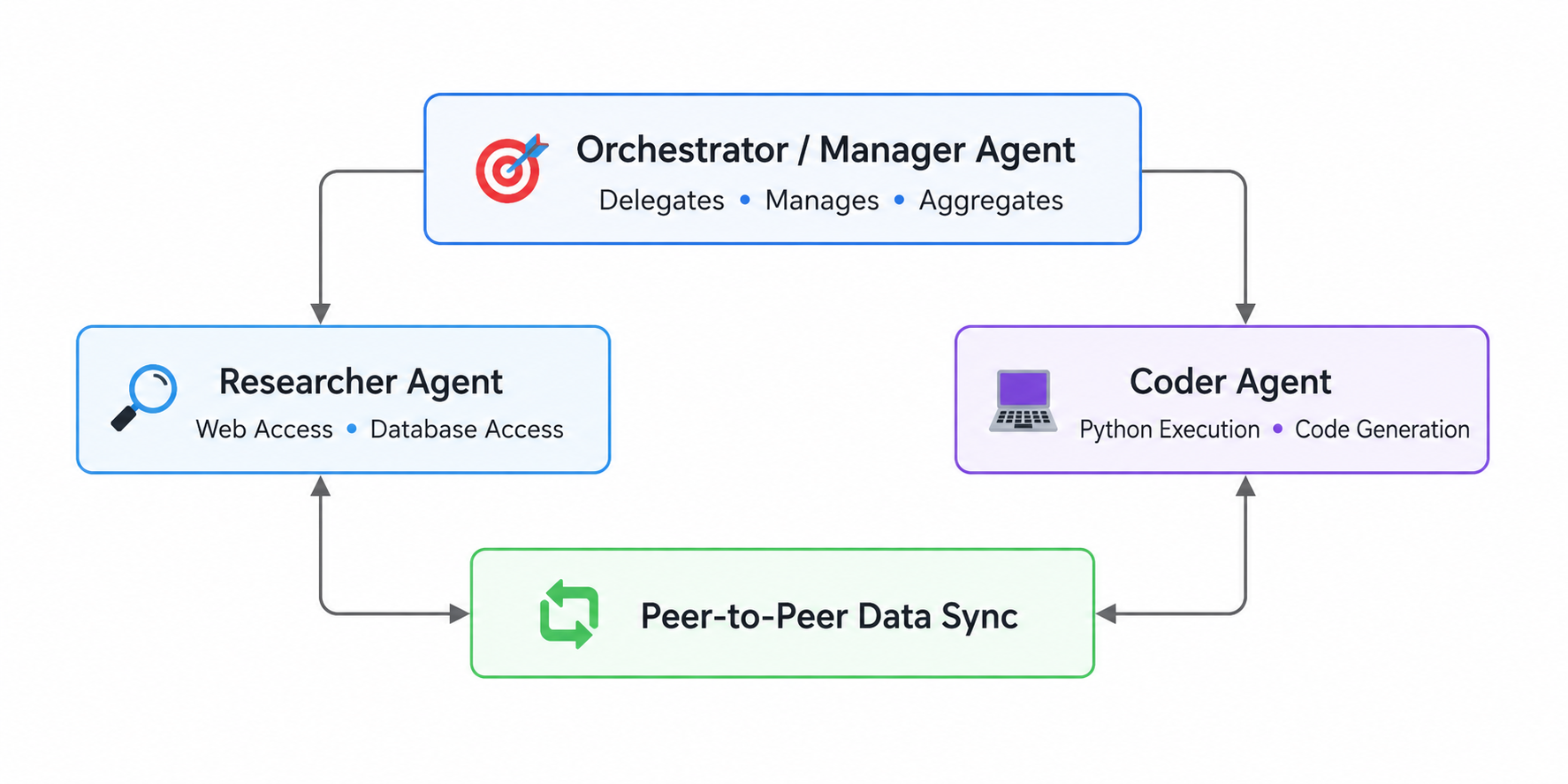
Collaborative AI agents operate through structured communication protocols. Using agent orchestration, a "Manager Agent" receives a prompt, breaks it into smaller sub-tasks, and routes those tasks to specialized worker agents. Once the workers complete their tasks, the Manager aggregates the findings. This peer-to-peer delegation mirrors a human corporate hierarchy.
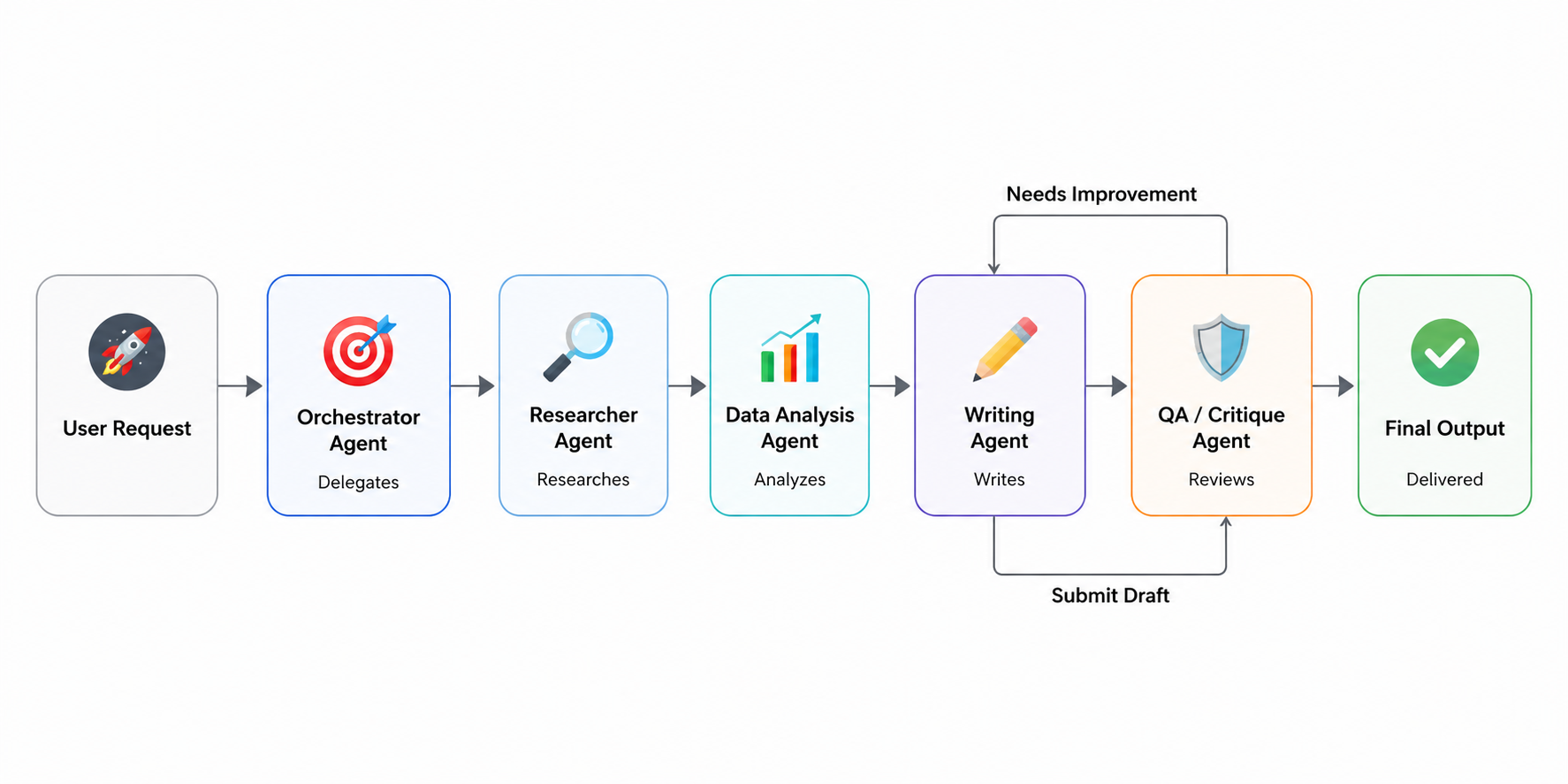
An AI agent workflow (or agentic workflows) is the predefined sequence of operations these agents follow. Agent workflow automation dictates whether agents operate sequentially (a pipeline), hierarchically (a manager/worker dynamic), or in a fully autonomous debate format where agents argue until a consensus is reached.
This flowchart demonstrates a standard sequential and recursive AI agent workflow used for content generation and validation.
This ASCII diagram showcases how enterprise AI agents collaborate under a central orchestrator.
| Mistake | The Impact | The Solution |
|---|---|---|
| Infinite Agent Loops | Agents continuously debate or pass tasks back and forth without resolving the prompt. | Implement a "max_iterations" cap and force a fallback to human review. |
| Overlapping Tools | Multiple agents have access to the same web scraper, causing redundant API calls. | Strictly silo tools. Only the Researcher agent should have internet access. |
| Vague Delegation | The Orchestrator agent sends ambiguous tasks to workers, resulting in poor outputs. | Program the Orchestrator to enforce strict JSON schemas when passing tasks. |
A: They can be, due to the high volume of underlying LLM calls. However, by using smaller, highly tuned open-source models (like Llama 3 8B) for simple worker agents, and reserving massive models (like GPT-4o or Claude 3.5 Sonnet) only for the Orchestrator, you can dramatically optimize costs.
A: An LLM is simply a reasoning and text-generation engine. An AI agent is an LLM wrapped in a software framework that allows it to retain memory, utilize external tools, and execute actions autonomously.
The transition from solitary LLMs to multi agent systems is the defining technical leap of 2026. By treating AI not as a singular magic oracle, but as a collaborative workforce of specialized digital employees, enterprises can automate deeply complex, multi-stage workflows. Mastering agentic workflows is no longer just an engineering flex—it is a fundamental requirement for scaling operations in the modern digital economy.


Devang Bhardwaj is an AIML Engineer at DotStark Technologies (India) Pvt. Ltd., specializing in machine learning, deep learning, and GenAI-driven systems. With hands-on experience building end-to-end intelligent solutions - from data preparation and model development to API integration and deployment - he has worked on projects spanning RAG systems, computer vision, forecasting, and fine-tuning workflows. Skilled in Python, SQL, FastAPI, LangChain, PyTorch/TensorFlow, Docker, and vector database-based architectures, Devang is passionate about solving real-world problems through practical AI and continuously building systems that are both intelligent and production-ready.
Follow on LinkedIn