For decades, the formula for business growth was simple but painful: to double your output, you had to double your headcount. Scaling meant ballooning HR costs, siloed departments, and an inevitable increase in operational bottlenecks. But what if you could scale your enterprise's output exponentially without adding a single physical desk?
We are no longer just using AI to draft emails or summarize meeting notes. The transition from individual AI productivity tools to comprehensive multi agent systems is fundamentally rewriting the economics of scaling a company. By deploying specialized "digital workforces," companies are unlocking unprecedented levels of intelligent business automation.
Even the most talented human teams face hard limits. A sales representative can only dial so many numbers. A support agent can only resolve so many tickets simultaneously. When workflows cross departmental lines—say, a closed deal moving from Sales to Onboarding to Customer Success—human handoffs create friction, data loss, and delays.
Standalone software tools haven't solved this; they've just digitized the silos. To achieve true AI process automation, businesses need a system that can think, route, execute, and communicate across boundaries autonomously. This is the promise of agentic AI for enterprises.
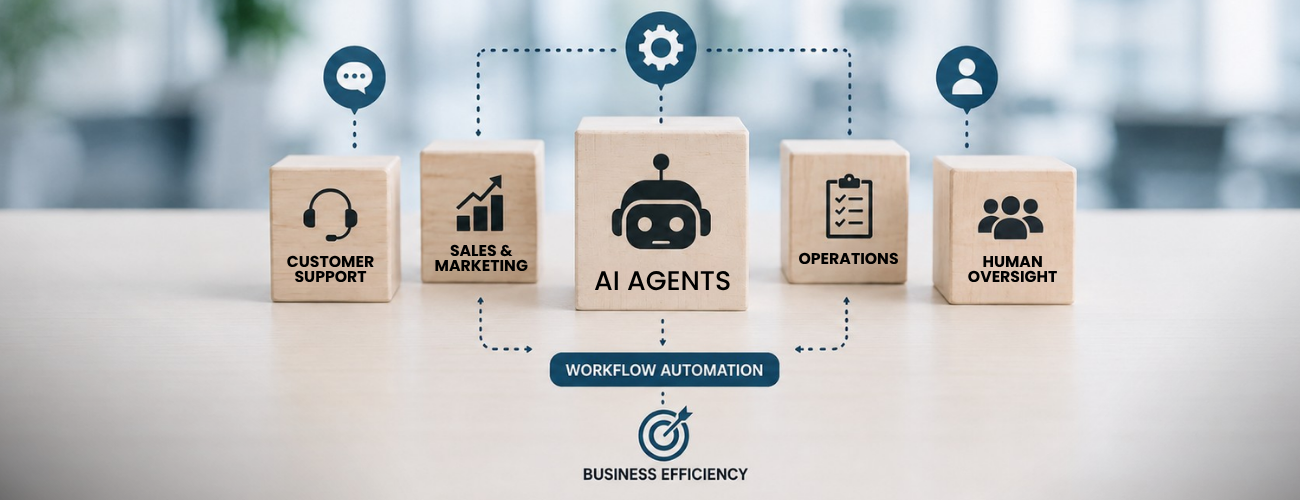
A multi-agent system operates like a finely tuned corporate department that works 24/7 at the speed of computation. Efficiency skyrockets because these systems eliminate wait times, minimize human error, and execute parallel processing. Let's look at how enterprise AI solutions deploy agents across key departments:
Traditional bots frustrate users by looping through pre-written menus. AI agents for customer support actually resolve issues. They can instantly retrieve a user's billing history, authenticate their account, process a refund via the Stripe API, and update the CRM—all in seconds, leaving human agents to handle only high-touch, emotionally complex escalations.
Imagine a scenario where AI agents for marketing scrape web signals for buying intent, immediately triggering AI agents for sales to generate hyper-personalized outreach emails. If the prospect replies, the agent autonomously negotiates a meeting time and updates the calendar. This creates an always-on pipeline.
Behind the scenes, AI agents for operations continuously audit inventory, cross-reference vendor pricing, and flag compliance risks. They transform reactive management into predictive optimization.
Absolutely. While single LLMs execute tasks, multi agent systems execute end-to-end workflow automation. Instead of human managers checking off boxes, a Manager Agent delegates tasks to Sub-Agents, reviews their work against quality metrics, and finalizes the deliverable—functioning as a self-contained operational loop.
Identify your most expensive, time-consuming, and repetitive cross-departmental workflow (e.g., client onboarding).
Define which digital roles need to be filled. You might need a Data Extraction Agent, a Verification Agent, and a Welcome Agent.
Business automation AI only works if your agents can "touch" your tools. Connect your multi-agent framework to your ERP, CRM, and communication channels.
Run your AI agents alongside human workers first. Compare the AI's autonomous decisions against the human's actions to tune the system before taking it live.
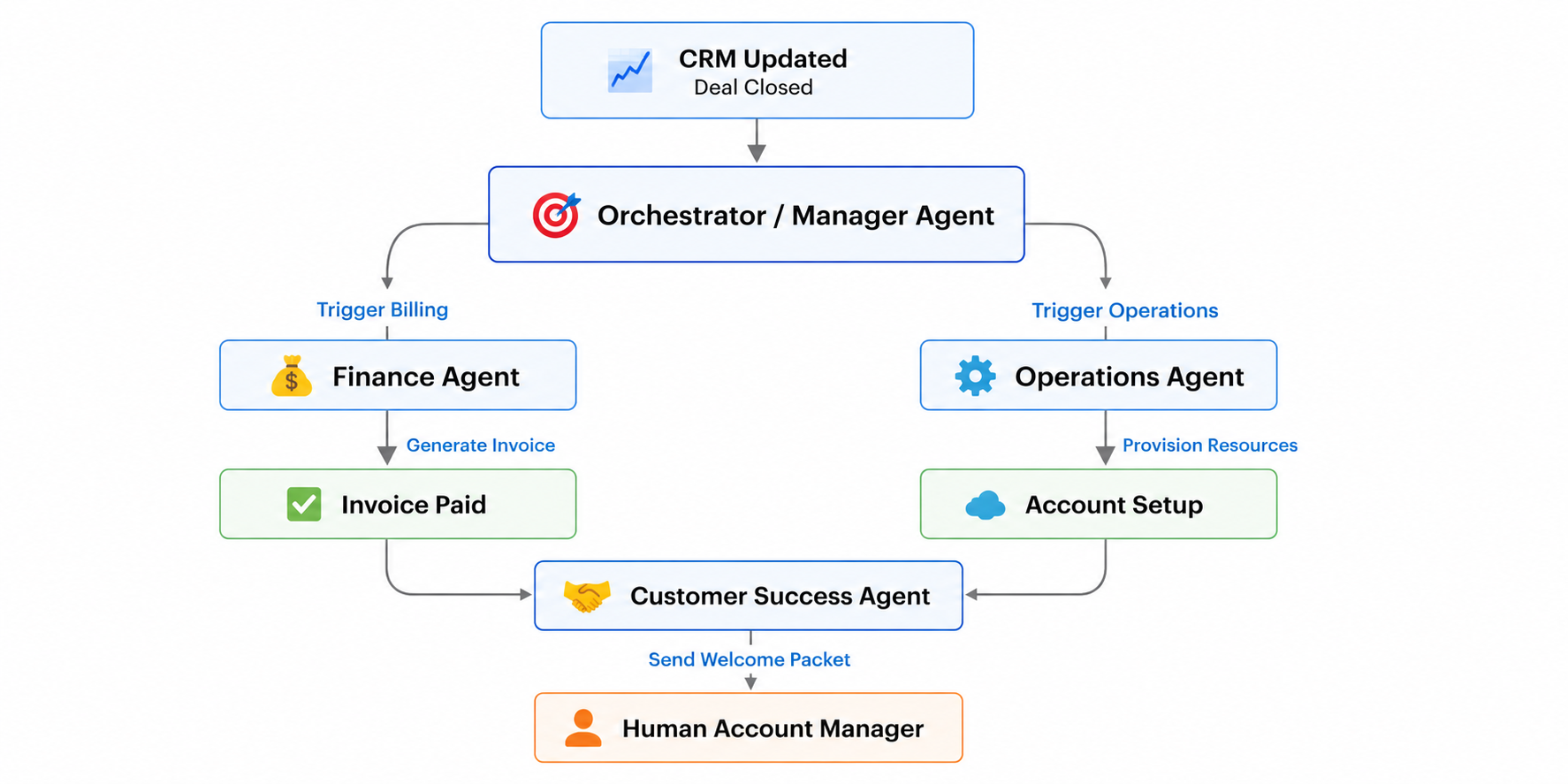
This flowchart visualizes how a multi-agent system handles a complex, cross-functional business event: closing a new B2B client.
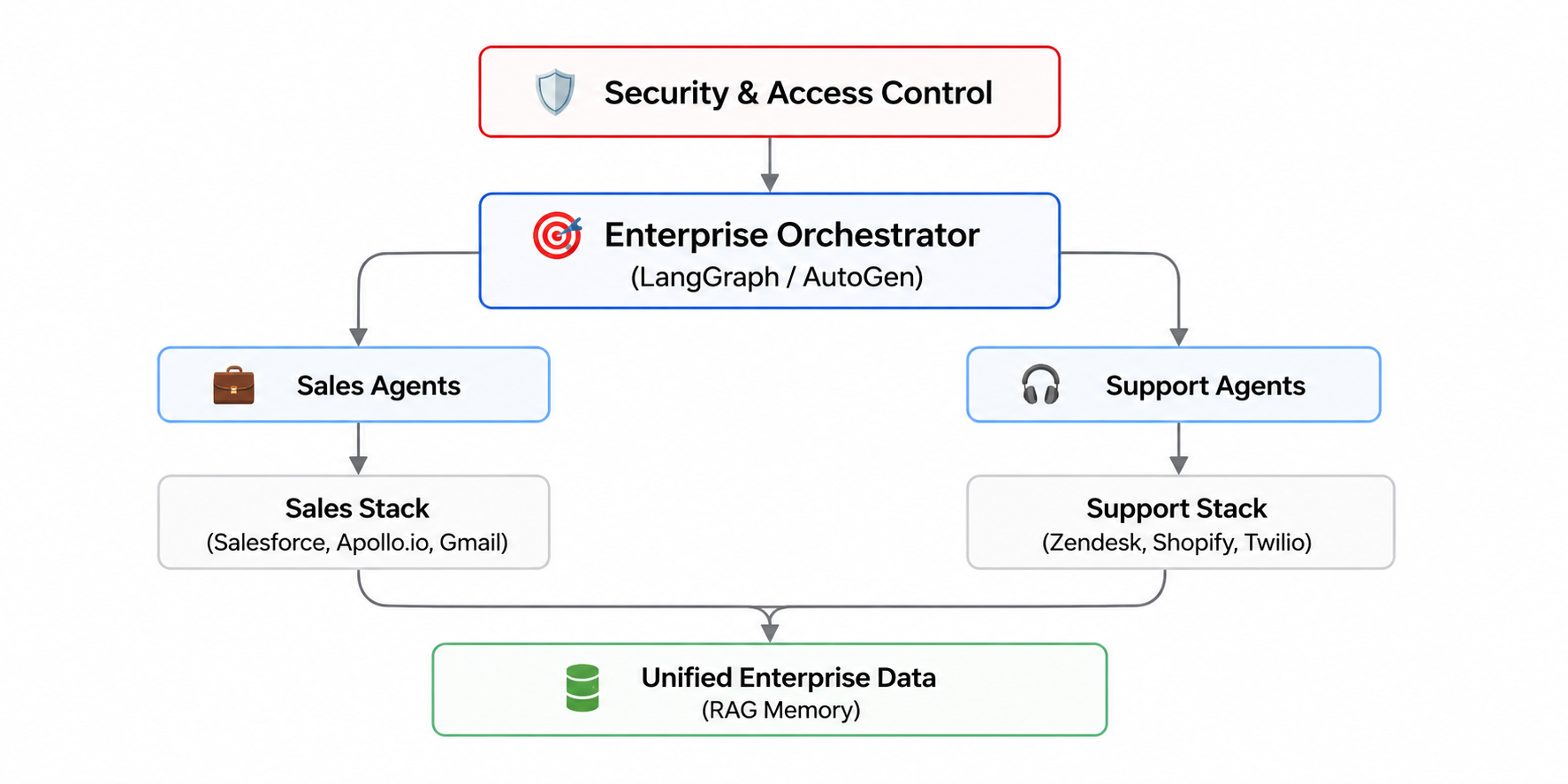
This ASCII diagram illustrates the structural hierarchy of AI agents for business securely integrated into a corporate environment.
| Mistake | The Consequence | The Solution |
|---|---|---|
| Automating Broken Processes | You simply scale your operational inefficiencies faster. | Lean out and document the ideal human workflow before introducing AI agents. |
| The "Set It and Forget It" Myth | APIs change, data structures shift, and agents break. | Assign a human "Agent Manager" to monitor logs and update system connections quarterly. |
| Ignoring Human Empathy | Using agents for high-stakes customer apologies damages brand trust. | Use agents for speed and data; escalate to humans for empathy and nuance. |
A: While specific numbers vary by industry, enterprise implementations frequently see a 40-60% reduction in operational processing costs, combined with a 10x increase in speed-to-resolution for routine tasks. The ROI comes from both saved labor hours and increased throughput capacity.
A: Yes, provided they are built correctly. Modern enterprise AI solutions utilize private, self-hosted models or enterprise-tier APIs (like Azure OpenAI) that guarantee your proprietary data is not used to train public models.
The implementation of multi agent systems marks the transition from software as a tool to software as a workforce. By effectively deploying AI agents for business, companies can decouple their growth trajectory from their overhead costs. Intelligent business automation is no longer a futuristic concept—it is the baseline competitive advantage of the modern enterprise.

To double your revenue, you used to have to double your headcount. Not anymore. 📉➡️📈 Discover how Multi-Agent Systems are decoupling growth from overhead. Read the blueprint here: #AgenticAI #BusinessAutomation
Software isn't just a tool anymore—it's a workforce. If your departments are still struggling with manual data handoffs and siloed workflows, you are losing to competitors leveraging Agentic AI. I just broke down exactly how AI Agents are transforming operations, sales, and support. Check it out: [Link]

Devang Bhardwaj is an AIML Engineer at DotStark Technologies (India) Pvt. Ltd., specializing in machine learning, deep learning, and GenAI-driven systems. With hands-on experience building end-to-end intelligent solutions - from data preparation and model development to API integration and deployment - he has worked on projects spanning RAG systems, computer vision, forecasting, and fine-tuning workflows. Skilled in Python, SQL, FastAPI, LangChain, PyTorch/TensorFlow, Docker, and vector database-based architectures, Devang is passionate about solving real-world problems through practical AI and continuously building systems that are both intelligent and production-ready.
Follow on LinkedIn