Two years ago, "Prompt Engineer" was hailed as the hottest job of the decade. Companies rushed to hire "AI whisperers" who could craft the perfect string of words to make Large Language Models (LLMs) output exactly what they wanted. But in the fast-paced world of artificial intelligence, paradigms shift in months, not years.
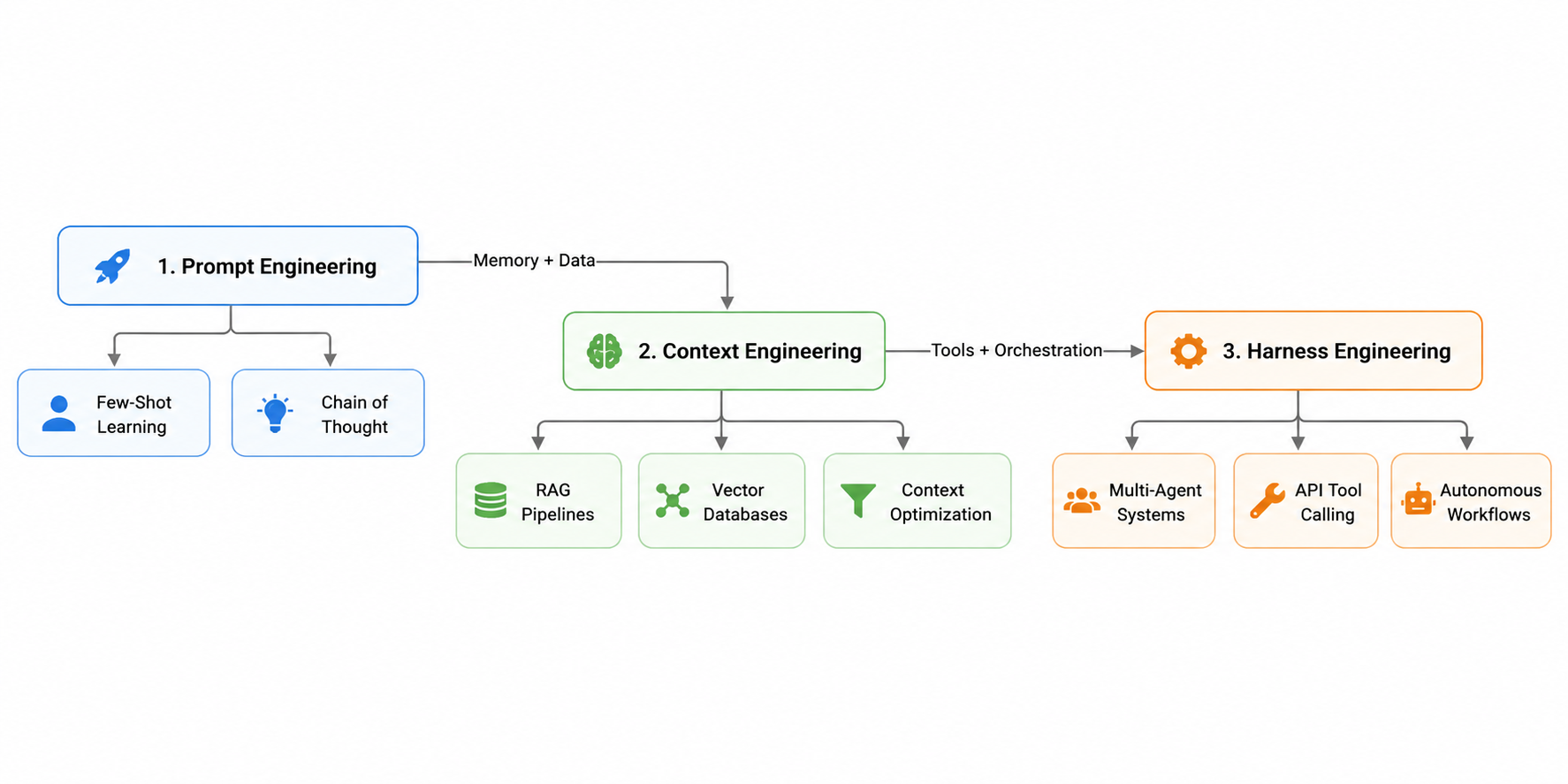
Today, the illusion of the "magic prompt" has shattered. Relying solely on prompt engineering to build enterprise AI applications is like trying to fly a commercial jet using a remote control. To build resilient, autonomous, and highly accurate AI systems, the industry has undergone a radical prompt engineering evolution. We have moved beyond crafting words, shifting first to Context Engineering, and now, to the frontier of Harness Engineering.
When businesses attempt to scale AI, they immediately hit the "context wall." An LLM natively has no memory of your business logic, proprietary data, or workflows. A brilliant prompt cannot fix an LLM that lacks the necessary factual grounding. This leads to hallucinations, repetitive errors, and fragile applications that break the moment a user asks a slightly unexpected question.
Furthermore, an LLM acting in isolation is just a text generator. It cannot push a button, update a database, or route an email. To unlock true ROI, AI needs a memory system (Context) and an operational framework (Harness) to execute actions in the real world.
Prompt engineering is the foundational layer—the art of instructing an AI. It focuses entirely on input syntax: using techniques like zero-shot, few-shot, and Chain-of-Thought (CoT) to guide the LLM's logic. While still relevant for ad-hoc tasks, prompt engineering vs context engineering represents the shift from instructing an AI to grounding an AI.
Context Engineering is the systematic process of designing, curating, and injecting the right external data into an LLM's context window precisely when it is needed. It moves beyond static prompts into dynamic AI context management, utilizing Retrieval-Augmented Generation (RAG), vector databases, and semantic search to ground the AI in factual reality.
Because an LLM is only as smart as the information it holds in its active memory. Context optimization ensures that an AI doesn't just guess; it reads from your enterprise's verified knowledge base before generating an answer. This is the cornerstone of enterprise context engineering.
By filling the LLM context window with hyper-relevant data chunks, context engineering directly eliminates hallucinations. Instead of relying on the AI's pre-trained (and potentially outdated) weights, the AI synthesizes an answer from the provided ground-truth documents.
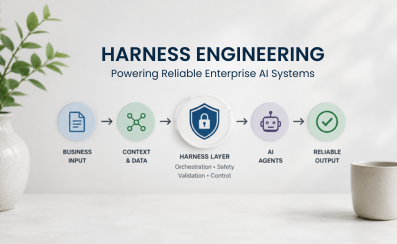
If prompt engineering is the steering wheel, and context engineering is the map, Harness Engineering is the entire vehicle. It is the comprehensive discipline of AI orchestration, system design, and workflow automation. AI harness engineering involves building the infrastructural "harness" that connects LLMs to APIs, decision-making logic, external tools, and multi-agent systems.
When looking at context engineering vs harness engineering, context gives the AI knowledge, but the harness gives the AI agency. It turns a passive chatbot into an active software system.
Transitioning to a harness engineering AI model requires a shift in architectural thinking. Here is how to build your first AI Harness:
create_user_account(), send_welcome_email()).This flowchart illustrates the evolutionary leap from basic prompting to complex AI workflow engineerin
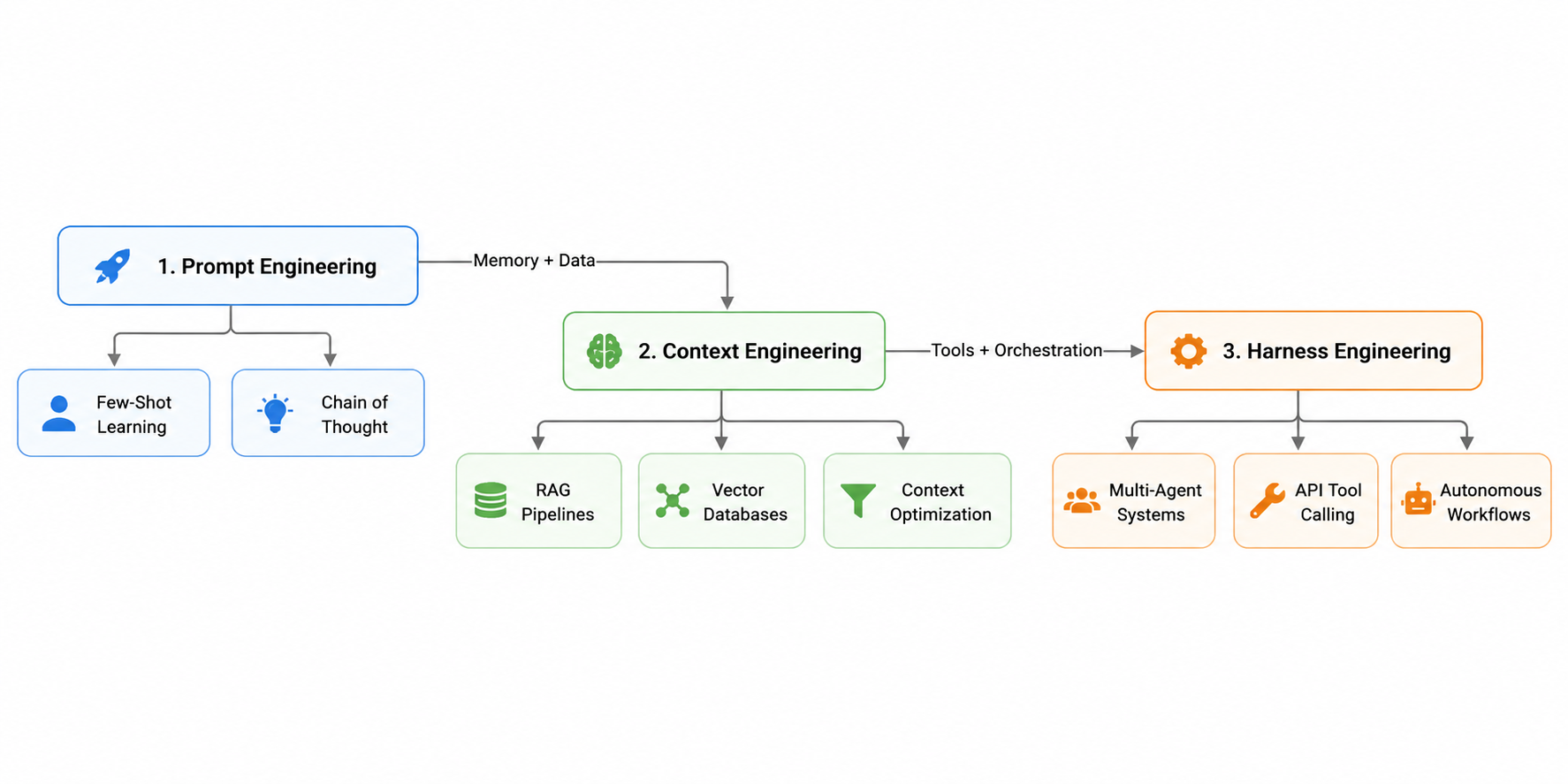
This ASCII diagram showcases a modern AI system design under the Harness Engineering framework.
| Mistake | The Consequence | The Solution |
|---|---|---|
| Treating LLMs as Databases | Relying on the model to "remember" facts leads directly to hallucinations. | Shift to context engineering for AI agents. Provide facts via RAG at runtime. |
| Ignoring Error Handling | When an LLM formats an API call incorrectly, the entire workflow crashes. | Implement validation loops within your AI orchestration layer to auto-correct formatting errors. |
| Overstuffing the Context | Putting too much data in the prompt dilutes the AI's focus ("Lost in the Middle" syndrome). | Use a strict context optimization pipeline to only inject top-K relevant documents. |
A: It evolved out of necessity. Developers realized that spending hours tweaking verbs in a prompt yielded diminishing returns. True capability required feeding the model external data (Context) and allowing it to use software tools (Harness), turning the model from a text generator into a reasoning engine.
A: The future of AI engineering is agentic AI engineering. AI will no longer be a chat interface you consult; it will be an invisible, background worker operating within a harness, executing multi-step enterprise tasks autonomously.
We are witnessing a profound maturity in how we build with artificial intelligence. While prompt engineering taught us how to speak to machines, and context engineering taught us how to give them memory, Harness Engineering is teaching us how to integrate them into the fabric of enterprise software. To build the next generation of reliable, autonomous AI, developers must stop asking "What is the right prompt?" and start asking "What is the right harness?"


Shivansh Sharma is an Al/ML Engineer at DotStark Technologies (India) Pvt. Ltd., specializing in machine learning, deep learning, and LLM-based systems. With hands-on experience building end-to-end intelligent pipelines - from data ingestion and model deployment to production-grade Al systems - he has delivered projects achieving up to 95% accuracy and 60% improvement in execution efficiency. Skilled in Python, SQL, LangChain, TensorFlow, and cloud deployment, Shivansh is passionate about solving real-world problems through Al and continuously pushing the boundaries of intelligent automation.
Follow on LinkedIn