Large Language Models (LLMs) have fundamentally disrupted enterprise computing. However, for CTOs, technical product managers, and enterprise decision-makers, deploying them into production reveals a glaring, systemic vulnerability: standard LLMs hallucinate, lack real-time context, and know absolutely nothing about your company's proprietary data. In high-stakes corporate environments, a confidently delivered wrong answer isn’t just a minor glitch—it is a massive compliance, legal, and operational liability.
To move past generic chatbots and unlock true operational leverage, organizations are turning away from costly, static model fine-tuning. Instead, they are adopting a dynamic alternative: Retrieval Augmented Generation. By decoupling a model's reasoning capabilities from its static training data, RAG AI bridges the gap between raw linguistic power and trusted corporate truth.
Standard LLMs suffer from a strict cut-off date and a complete lack of internal auditability. When asked a proprietary question, they attempt to predict the next logical word based on their training parameters rather than verifying facts. This leads to information staleness and baseline fabrications. The gap between a risky, unpredictable model and a secure corporate engine is bridged by a robust enterprise RAG framework.
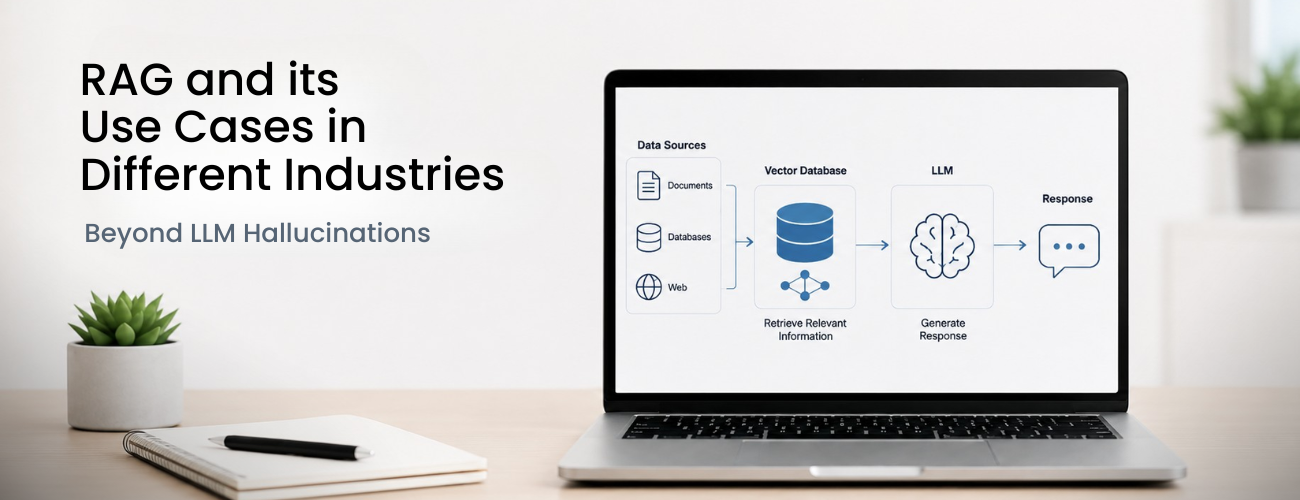
At its core, a modern RAG architecture acts as a secure intermediary between a user's prompt and an underlying LLM. Instead of forcing the model to rely solely on its internal memory, RAG systems first query an optimized reference library to pull contextually accurate, real-time data before formulating a response. This process turns a standard LLM with RAG setup into a highly specialized, fact-checked expert.
This systematic layout powers true AI knowledge retrieval, organizing unformatted corporate documentation directly into an indexed vector database RAG. When a query occurs, advanced AI search systems fetch the most textually and semantically relevant chunks, passing them cleanly to the model alongside the initial instruction. This makes generative AI with RAG exceptionally reliable.
The architectural logic for a modern RAG framework maps out how data transitions from raw corporate records into grounding context for an LLM
Understanding the server-side relationship is critical for implementing an enterprise RAG pipeline. Here is a high-level visual map of the tech stack:
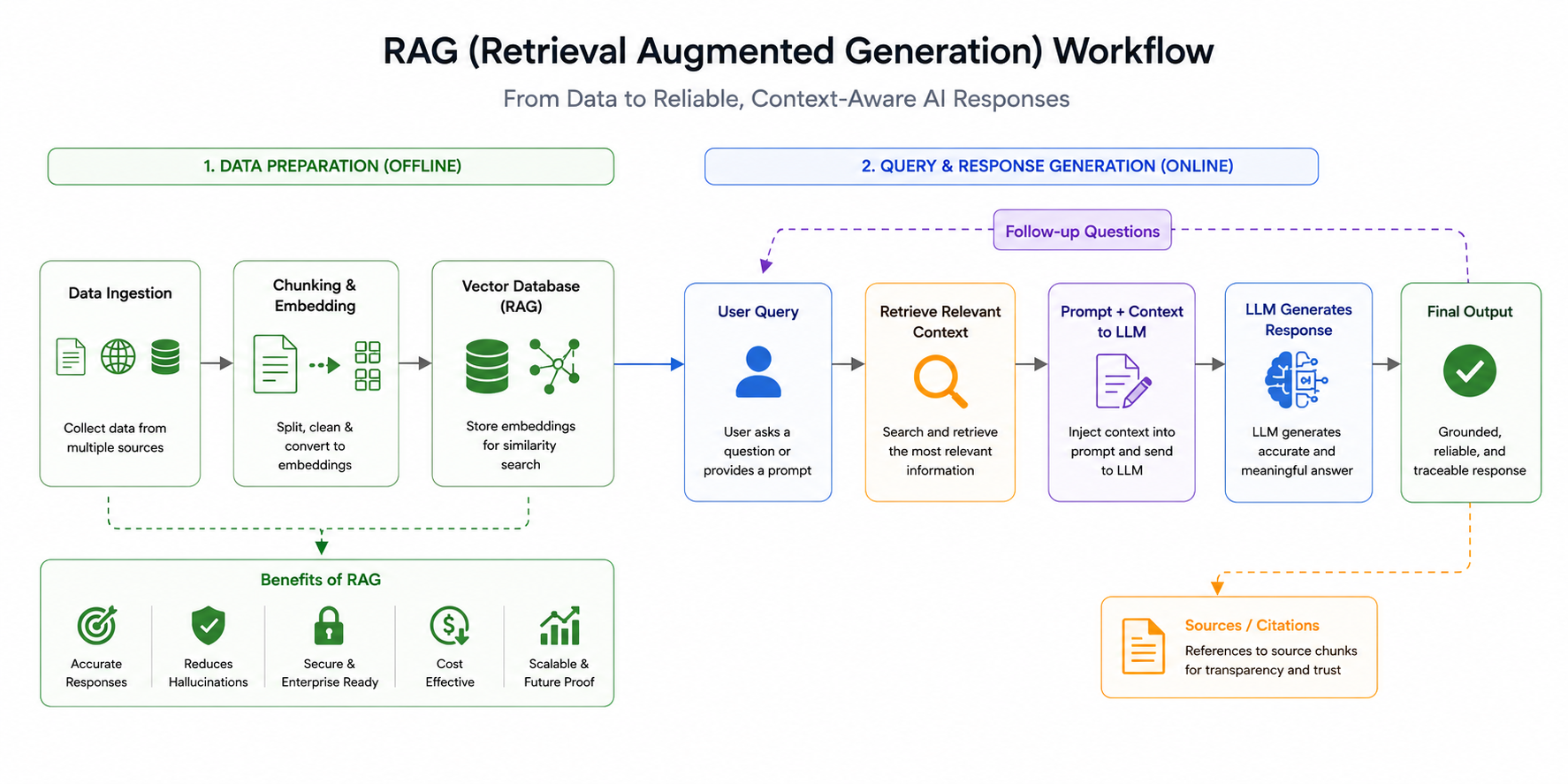
The practical application of RAG in AI spans nearly every sector requiring absolute data precision. Let's look at how specific verticals are deploying unique RAG use cases to solve critical problems.
Medical professionals cannot tolerate factual errors. By implementing an enterprise-grade RAG framework, hospitals and research labs link clinical LLMs directly to vetted peer-reviewed journals, up-to-date genomic databases, and internal institutional treatment guidelines. Doctors can instantly query complex patient charts against millions of medical documents to assist with diagnostic verification, avoiding the risk of hallucinated drug interactions.
In finance, market parameters shift by the millisecond. Financial analysts use RAG applications to analyze real-time earnings call transcripts, SEC filings, and global macroeconomic indicators simultaneously. Because the underlying documentation updates continuously within the retrieval layer, the generated summaries, risk assessments, and investment briefs remain accurate and fully auditable without requiring constant model retraining.
Legal discovery requires scanning through mountain-sized archives of case law, corporate contracts, and changing jurisdictional regulations. Legal tech firms integrate RAG systems to let attorneys instantly pull relevant precedents or flag compliance risks across thousands of historical files. Because every answer references back directly to its original document source link in the vector database RAG, verification takes minutes instead of days.
Traditional hard-coded support trees are brittle, while raw LLM bots risk making up fictitious promotional discounts. Customer support teams employ generative AI with RAG to index entire product manuals, shipping rules, and refund criteria. The customer experiences a fluid, highly understanding conversation while the executive leadership team rests assured the bot will only quote verified corporate policies.
| Operational Vector | Standard Out-of-the-Box LLM | Enterprise RAG System |
|---|---|---|
| Information Freshness | Static (limited by training cutoff date) | Real-Time (dynamic data indexing via vector stores) |
| Hallucination Rate | High (generates fiction when data is missing) | Near-Zero (strictly grounded to retrieved context) |
| Auditability & Trust | None (opaque black box outputs) | Full (provides explicit source citations and links) |
| Implementation Cost | Extremely High (requires deep compute for fine-tuning) | Moderate (capitalizes on existing APIs and databases) |
A: No. The primary advantage of a RAG framework is that it uses out-of-the-box foundation models as reasoning engines. Instead of altering the model's weights, you simply provide the correct information directly in the prompt context window.
A: When deployed using private cloud architectures (VPC) and secure API endpoints, your data remains completely isolated. Your internal documentation is stored securely in your own encrypted vector database RAG and is never shared with public model training pools.
Transitioning generative AI from a proof-of-concept novelty to an enterprise-grade utility requires absolute data fidelity. Deploying a structured RAG architecture allows your business to harness the unmatched reasoning power of frontier language models while maintaining strict control over data grounding, auditability, and corporate intellectual property.
Executive Summary: Stop fighting model hallucinations with prompt adjustments. Ground your corporate AI strategy in verifiable truth using an intelligent data retrieval architecture.


Priyanshu Raj is an AI Intern at DotStark Technologies (India) Pvt. Ltd., specializing in Generative AI, Retrieval-Augmented Generation (RAG), and AI-powered chatbot development. With hands-on experience in designing and developing end-to-end intelligent applications, he has worked on building a production-ready Website RAG Chatbot that enables users to interact with website content using natural language. His work includes implementing website crawling, text processing, vector embeddings, semantic retrieval, Redis-based caching, real-time response streaming, and LLM integration. Skilled in Python, FastAPI, React, Redis, Qdrant, Groq API, LangChain, Vector Databases, and Large Language Models (LLMs), Priyanshu is passionate about building scalable AI systems that solve real-world business problems. He continuously explores emerging AI technologies and focuses on developing intelligent, efficient, and production-ready AI solutions.
Follow on LinkedIn