In today's competitive digital landscape, the ability to deeply understand your customers and respond in real time is not a luxury - it is the baseline expectation. Customer Data Platforms (CDPs) have emerged as the connective tissue linking customer behaviour, content strategy, and marketing execution. For organisations running on Kentico, the story gets even more compelling: Xperience by Kentico ships with a native, integrated CDP that eliminates the complexity and cost of bolting on a separate data platform.
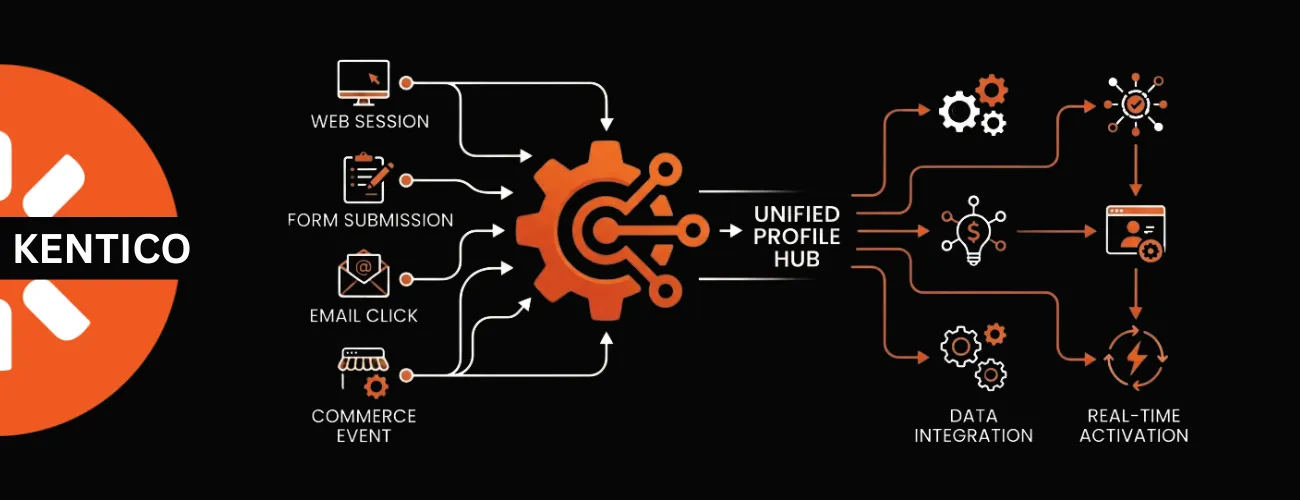
A Customer Data Platform is a system that collects and unifies customer data from multiple sources - web sessions, form submissions, email interactions, commerce events - and makes that unified profile available to marketing and personalisation tools. Unlike a CRM (which stores company-managed relationship data) or a DMP (which deals with anonymous audience segments), a CDP is built around persistent, addressable individual profiles enriched by behavioral signals over time.
According to Kentico's official platform documentation, Xperience by Kentico includes a native CDP that collects and unifies customer data, and enables personalisation, segmentation, and better customer insights across the platform. Unlike standalone CDP tools, Kentico's implementation is natively connected to the content layer - meaning data and content work in sync without custom integrations.
*Source: Kentico survey, 2025 - kentico.com/platform/digital-marketing
Xperience by Kentico automatically tracks visitor activity and builds contact profiles that store marketing-related information. Activities represent actions that users take throughout their digital experience visiting pages, submitting forms, clicking email links, or completing commerce events. These activities can trigger automation processes and segment contacts into groups, and custom activity types can be defined for organisation-specific scenarios.
Contact segmentation in Xperience by Kentico helps divide website visitors into groups of shared characteristics. According to Kentico's official segmentation documentation, segmenting contacts based on their behaviour, demographics, and interests helps organise the contact database and focus targeting of communication to the right audience. For example, contacts from the same country who showed interest in the same content can be grouped together - everyone within the group then receives information tailored to their needs.
Contact groups in Xperience by Kentico can be condition-based: when a contact is created or updated, the system automatically checks whether the contact fulfils the conditions of each group and adds or removes them accordingly. This means segments remain accurate without manual intervention.
The connection between contact segmentation and content delivery is where Kentico's integrated CDP truly differentiates itself. According to Kentico's content personalisation documentation, the system segments website visitors into contact groups based on their activities, and the site then displays personalised content depending on the groups to which the current visitor belongs.
Personalisation in Xperience by Kentico works at the Page Builder widget level, enabling marketers to configure different variants of each widget based on conditions with no developer handoff required for routine changes. Developers can also write personalisation conditions directly in code, fetching different content or calling different business logic based on contact group membership.
Kentico's CDP layer includes built-in consent management to ensure compliance with regional privacy regulations such as GDPR and CCPA. Consent is tracked at the contact level and integrated with all data-collection touchpoints forms, tracking scripts, and email subscriptions. Deleting a contact from the system also removes their consent agreements, supporting the right-to-erasure requirements under GDPR.
While Xperience by Kentico's native CDP covers the needs of most mid-market organisations, some enterprises already operate an external CDP Salesforce Data Cloud, Segment, mParticle, or similar and need Kentico to participate in that ecosystem. Kentico's open integration architecture is designed for exactly this scenario.
According to Kentico's integration documentation, teams can define their system of record, then sync contacts and activities via APIs. Xperience by Kentico's headless API supports contact creation, consent management, and activity tracking meaning web and email behaviours can be captured in Kentico while identifiers and profile updates are pushed to an external CRM or CDP simultaneously.
Out-of-the-box, Kentico ships with pre-built CRM connectors for Salesforce and Microsoft Dynamics, plus open-source starter kits for HubSpot, Zoho, and Sugar CRM. The open-source CRM integration package is available on GitHub and can be extended to connect any system.
Data Silos Between CDP & CMS
Customer profiles in an external CDP are disconnected from the content layer, making real-time personalisation dependent on slow API calls or batch syncs that introduce delays.
Use Kentico's contact tracking API and global event handlers to push behavioural events to the external CDP in real time, and pull segment membership back into Kentico contact groups for personalisation decisions.
Marketing Automation Complexity
According to Kentico's blog (March 2025), stand-alone automation tools require extensive integration with CMS, CRM, CDP, email, and personalisation platforms before delivering any value demanding IT resources most mid-sized teams do not have.
Kentico's built-in marketing automation connects natively with the Content Hub, personalisation, segmentation, forms, tracking, and consent removing integration overhead and enabling marketers to build workflows from day one.
Search & Commerce Outside the CDP
Product recommendation engines and site search tools operate independently, missing the rich behavioural profile Kentico holds about each contact.
Kentico's integration layer supports Algolia AI Search, Azure AI Search, and Lucene for search, plus a Shopify quick-start integration for commerce. All can consume Kentico contact group data to deliver personalised results and recommendations.
A CDP's value is realised only when its data activates downstream experiences. Kentico's marketing automation module described in the official blog 'Boosting the value of marketing automation' (kentico.com, March 2025) connects natively with the platform's CDP layer. Triggers based on contact activity (form submission, page visit, email open), conditions drawn from contact group membership, and actions including personalized emails, custom activity logging, and contact field updates can all be assembled in a no-code drag-and-drop workflow designer.
Plan which contact fields, custom activities, and consent types you need before configuring tracking. Xperience by Kentico supports custom contact fields and developer-defined activity types designing these upfront avoids expensive retrofits after go-live.
Build contact groups around behavioural conditions pages visited, forms submitted, products viewed rather than relying on manually maintained lists. Kentico automatically adds or removes contacts when conditions change, ensuring segments remain accurate without staff overhead.
Use Kentico as the real-time behavioural layer and your CRM as the long-term relationship record. The open-source CRM integration package (available on GitHub) supports bidirectional sync: leads flow from Kentico to the CRM, while sales-stage and account data enriches Kentico contact profiles.
Kentico's built-in consent management should be applied at every form, tracking script, and email subscription to ensure GDPR and CCPA compliance from the start. Consent status is stored at the contact level and respected by all downstream personalisation and automation rules.
Contact groups are the bridge between the CDP and the experience layer. Attach automation workflows to contact group membership changes a contact entering the 'High Intent' group triggers a nurture sequence; leaving it pauses communication. This closes the loop between data collection and personalised engagement.
A CDP's value is realised only when it is connected to the content and automation layer. Kentico's native integration of contact tracking, segmentation, personalisation, consent, and marketing automation means the CDP is not a separate silo to maintain it is the platform itself. For organisations already on an external CDP, Kentico's open API and pre-built connectors make it a first-class citizen in any martech stack.
| Resource | Source |
|---|---|
| Digital Marketing (XbyK) | kentico.com/platform/digital-marketing |
| Integrations & Scalability | kentico.com/platform/integrations |
| Contact Segmentation Overview | docs.kentico.com/modules/contact-management/contact-segmentation-overview |
| Content Personalisation | docs.kentico.com/documentation/developers-and-admins/digital-marketing-setup/content-personalization |
| Segmentation Guide (XbyK Guides) | docs.kentico.com/guides/digital-marketing/work-with-contacts/contact-segmentation-overview |
| Boosting Marketing Automation | kentico.com/discover/blog/boosting-marketing-automation |
| CRM Integration (GitHub) | github.com/Kentico/xperience-by-kentico-crm |
| Customer Journeys Guide | docs.kentico.com/guides/customer-journeys |
| DXP Capabilities Handbook | docs.kentico.com/guides/architecture/xperience-implementation-handbook/examine-xperience-capabilities |
| CMS vs DXP Glossary | kentico.com/discover/glossary/cms-vs-dxp |
A Customer Data Platform, or CDP, collects customer data from different touchpoints such as website visits, form submissions, email interactions, and commerce activity. It then creates unified customer profiles that marketers can use for segmentation, personalization, and automation.
A CRM mainly stores sales and relationship data entered by teams, while a CDP focuses on real-time behavioral and demographic data collected from customer interactions. A CDP is more useful for personalization, segmentation, and marketing activation.
Yes. Xperience by Kentico includes native CDP capabilities that help collect and unify customer data, build contact profiles, create segments, and deliver personalized digital experiences.

With more than a decade of experience in designing and developing enterprise-grade applications, Manoj brings deep technical expertise and a solution-driven approach to software development. Specializing in modern technologies, cloud-native architectures, AI-powered applications, and system integrations, Manoj leads development teams in delivering secure, scalable, and business-focused solutions. Committed to engineering excellence and innovation, Manoj enjoys solving complex technical challenges while helping organizations accelerate their digital transformation journey.
Follow on LinkedIn