.png)
What if the biggest drain on your website budget wasn't the initial build but everything that happens after launch? For most enterprises, that's exactly where the money quietly disappears.
Building a website is a one-time project. Maintaining it isn't it's a recurring bill that shows up every month, long after the launch celebration is over.
In this post we'll walk through:
Most enterprise websites accumulate cost from the same handful of places, year after year:
Annual licensing for an enterprise CMS can already run into five figures, and on top of that, hosting, upgrades, and third-party integrations keep adding to the bill. The result is a website that costs far more to keep running than it cost to build and most of that spend goes toward friction, not features.
Xperience by Kentico brings CMS, marketing automation, personalization, and other digital marketing capabilities into a single platform. That means one login, one vendor relationship, and one system to patch and upgrade instead of stitching together separate tools that each carry their own maintenance overhead and integration risk.
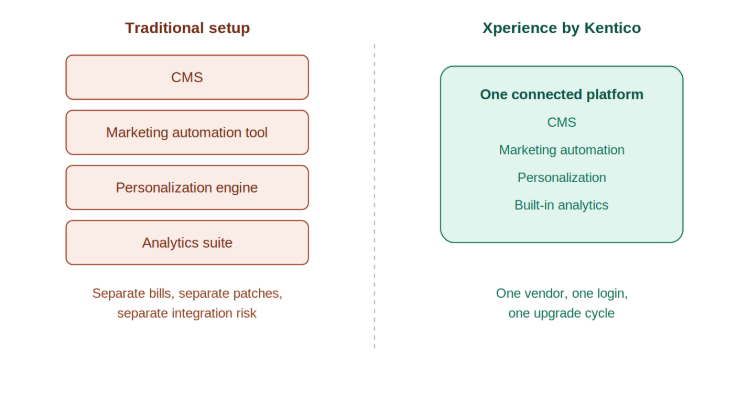
Through Page Builder, pages are assembled from reusable widgets, sections, and templates rather than hand-coded each time. A new landing page becomes an afternoon of assembly work for a marketer, not a development sprint.
Built on .NET Core, the platform is lighter weight than many legacy alternatives, which in practice translates to lower hosting costs and fewer performance-related fixes down the line. Less code generally means fewer things that break.
For teams that choose the SaaS deployment model, a meaningful share of the traditional maintenance load server management, patching, uptime monitoring shifts to the vendor rather than sitting on an internal team's plate.
Here's what the maintenance cycle typically looks like on a traditional, multi-tool setup.
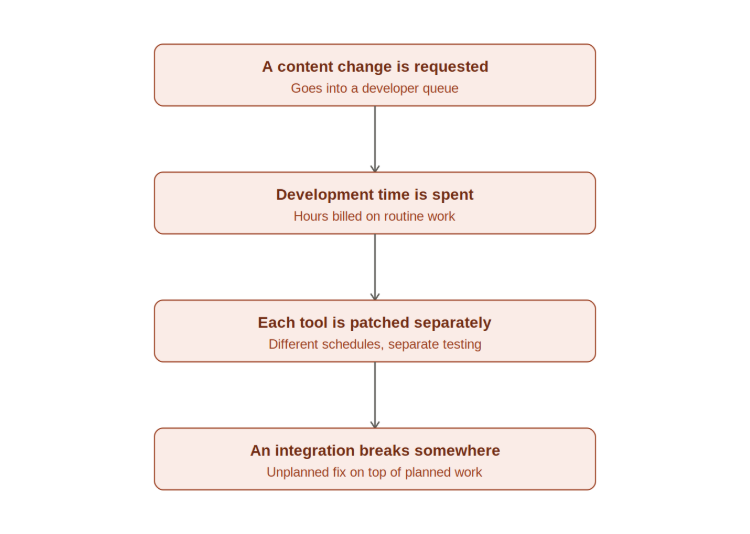
A marketer needs a page updated. Because the platform isn't built for self-service editing, the request goes into a developer queue.
A developer picks up the ticket, makes the change, tests it, and deploys it hours spent on work that didn't need specialized skills to begin with.
The CMS, the email platform, the personalization engine, and the analytics tool all need separate version upgrades and security patches, often on different schedules, each requiring its own testing cycle.
Because the tools weren't built to work together natively, an upgrade to one system quietly breaks an integration with another and now there's an unplanned fix on top of the planned maintenance.
Here's the same cycle, restructured around a unified platform.
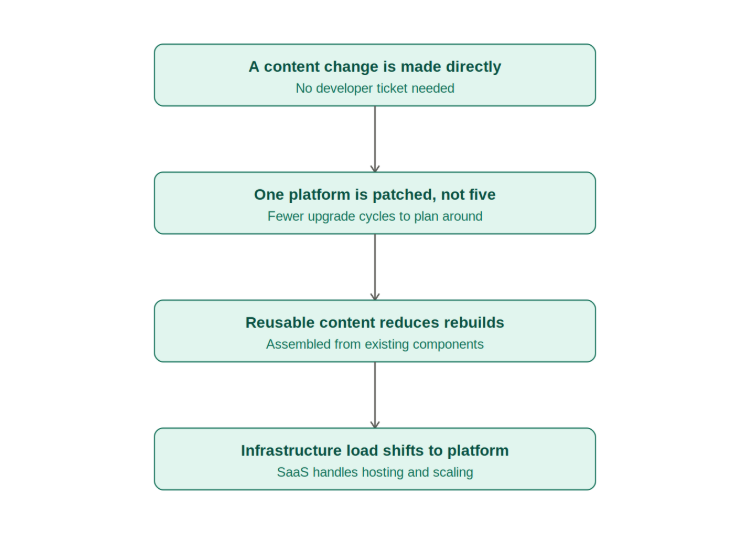
Developers prepare the Page Builder environment/components first, and then the marketer opens Page Builder, edits the page visually, and publishes it — no developer ticket required for routine content work.
Xperience can consolidate several capabilities into one platform, reducing the number of independently managed application platforms and associated upgrade cycles.
Because reusable content lives in a shared Content Hub and components are reusable, new pages and campaigns are assembled from existing building blocks instead of built from zero.
With SaaS deployment, hosting, scaling, and much of the operational upkeep is handled by the platform itself, freeing internal teams to focus on content and strategy instead of server maintenance.
Worth calling out specifically: the cost savings here aren't a side effect — they come from deliberate architectural choices. Reusable Page Builder components, configurable marketing automation, and a component-based content model are all decisions that can reduce the amount of routine development work required to keep a website functional.
| Cost Driver | Traditional Multi-Tool Setup | Xperience by Kentico |
|---|---|---|
| Platform count | CMS + marketing + personalization + analytics, separately | One unified platform |
| Routine content edits | Developer-dependent | Marketer self-service via Page Builder |
| New page creation | Custom-coded each time | Assembled from reusable components |
| Patching and upgrades | Separate cycles per tool | Centralized on one platform |
| Infrastructure management | Often fully in-house | Shifts to vendor with SaaS deployment |
| Integration risk | High — multiple systems to keep in sync | Low — natively connected modules |
Lower Developer Dependency for Everyday Work. Giving marketers a visual editor for routine changes is one of the most direct cost levers here — it removes a recurring line item from the development budget without removing quality control.
Fewer Vendor Relationships to Manage. Consolidating four or five tools into one platform doesn't just save subscription costs — it reduces the hidden cost of managing multiple vendor contracts, support tickets, and renewal cycles.
A Lighter Technical Footprint. Xperience by Kentico is built on modern .NET and ASP.NET Core technologies, providing a current application foundation for enterprise websites. Hosting requirements and infrastructure costs depend on factors such as application architecture, traffic, and implementation, rather than the underlying framework alone.
Reusability Compounds Over Time. The first few components take real effort to build well. After that, every additional page reuses them, and the cost-per-page keeps dropping the longer the platform is in use.
Licensing Isn't Free, Even If Maintenance Is Lower. Annual licensing for an enterprise-tier plan is a real cost, and it scales with usage. The savings show up in the maintenance column, not by making the platform itself free.
Migration Costs Are Front-Loaded. Moving from a legacy platform, especially across major version jumps, requires real development effort. The cost reduction is a multi-year story, not a first-quarter one.
SaaS Reduces Control Along With Effort. Handing infrastructure management to the vendor lowers maintenance work, but it also means less direct control over hosting configuration — a trade some enterprise IT teams are cautious about.
Savings Depend on Actually Using the Reusable Model. If teams keep building one-off, custom-coded pages instead of using Page Builder components, most of the maintenance savings simply don't materialize. The platform enables lower costs — it doesn't enforce them.
Reducing website maintenance costs isn't about finding one clever trick — it's about removing the recurring friction that accumulates when a website runs on disconnected tools and custom-built pages. Xperience by Kentico's approach is to consolidate the platform, shift routine work away from developers, and let infrastructure management move to the vendor where it makes sense.
None of this makes a website free to run. But it changes what the ongoing cost actually pays for — less spent holding fragile integrations together, more spent on the content and experience that the website exists for in the first place.
If your team is looking at where website spend is really going, the maintenance column is usually where the bigger, more fixable costs are hiding — not the initial build.
Want to see where your own website's maintenance spend is going? Contact our team for a free assessment of your current setup and where a platform like Xperience by Kentico could cut ongoing costs.

With more than a decade of experience in designing and developing enterprise-grade applications, Manoj brings deep technical expertise and a solution-driven approach to software development. Specializing in modern technologies, cloud-native architectures, AI-powered applications, and system integrations, Manoj leads development teams in delivering secure, scalable, and business-focused solutions. Committed to engineering excellence and innovation, Manoj enjoys solving complex technical challenges while helping organizations accelerate their digital transformation journey.
Follow on LinkedIn

.png)

_4.png)