.webp)
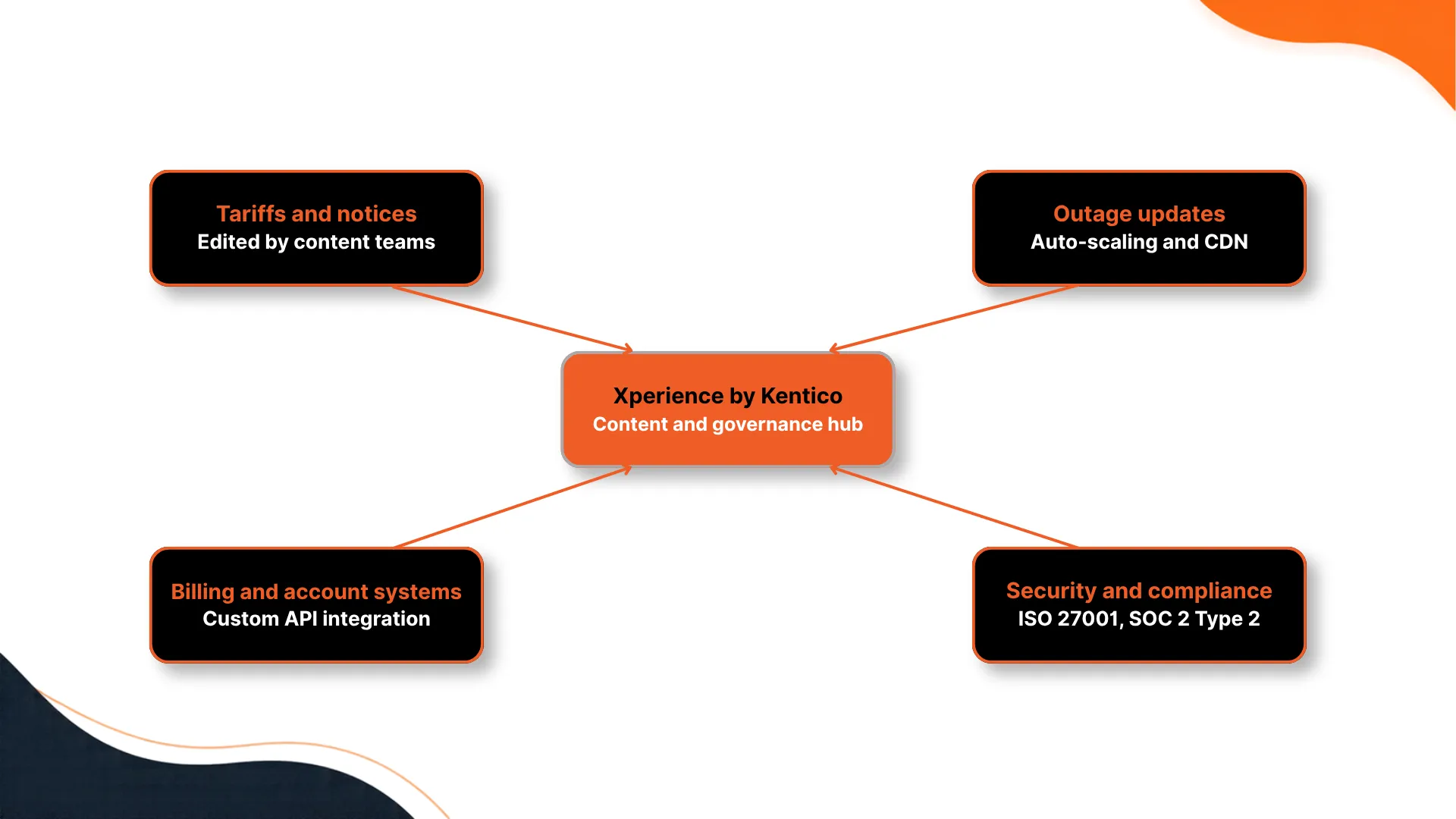
Xperience by Kentico suits energy and utility providers that need editors to control tariff and outage content directly, a certified secure platform, and a site that holds up under traffic spikes. Kentico's own industry hub says utility providers use the platform to give customers clarity and control over tariffs, accounts, and outages. The limits are just as clear: energy and utilities is not one of Kentico's dedicated industry verticals, and billing or account system connections need custom integration work rather than prebuilt connectors.
In this guide, we will cover:
A utility website carries a heavier load than most corporate sites. It has to explain pricing clearly, stay reliable when customers are stressed, and connect to systems that were built long before the web mattered. Legacy setups tend to fail in the same places:
None of these problems are unique to one provider. They come from asking a general purpose website setup to do a job that has strict timing, security, and integration requirements.
Tariffs, service notices, and energy saving guidance are content that changes often and must be accurate. Xperience by Kentico gives content teams a visual editing environment, so a rate change or a policy notice does not wait in a developer queue. Kentico also states that its platform includes role based access controls and audit trails, which matter when several people edit content that regulators may review.
Kentico's documentation says the SaaS offering is designed for 99.9 percent uptime and uses horizontal auto-scaling and a content delivery network. That is a sound base for outage days, when visitors arrive all at once. It is a base, not a guarantee, and a utility should still test its own pages under load.
Kentico says the platform is built on ISO 27001 and SOC 2 Type 2 standards, and that it includes cookie consent, data anonymization, and accessibility support aimed at WCAG standards. It also states a policy of fixing confirmed bugs within seven business days. For a regulated provider, these are useful starting points for a security review, not a replacement for one.
Customer accounts, billing, and outage data live in back office systems. Kentico lists out of the box CRM integrations for Salesforce and Microsoft Dynamics, an open .NET API, and a GraphQL headless API for custom work. It does not list prebuilt connectors for utility billing or customer information systems, so those links are custom development. We cover what that kind of work involves on our Xperience by Kentico development services page.
Here is what an outage day often looks like on a site that was not built for it. The steps are illustrative of a common pattern, not a measured case.
Customers cannot find information on the website, so they phone the contact center, which becomes the default source of updates.
The communications team has the message but not the access. The change waits for a developer or an agency to publish it.
Visitor numbers spike well above a normal day, and infrastructure sized for average traffic responds slowly or fails at the moment customers need it most.
Because each edit takes effort, the notice falls behind the actual situation, and customers lose confidence in what the page says.
Here is the same day, handled with editor control and a platform built to scale.
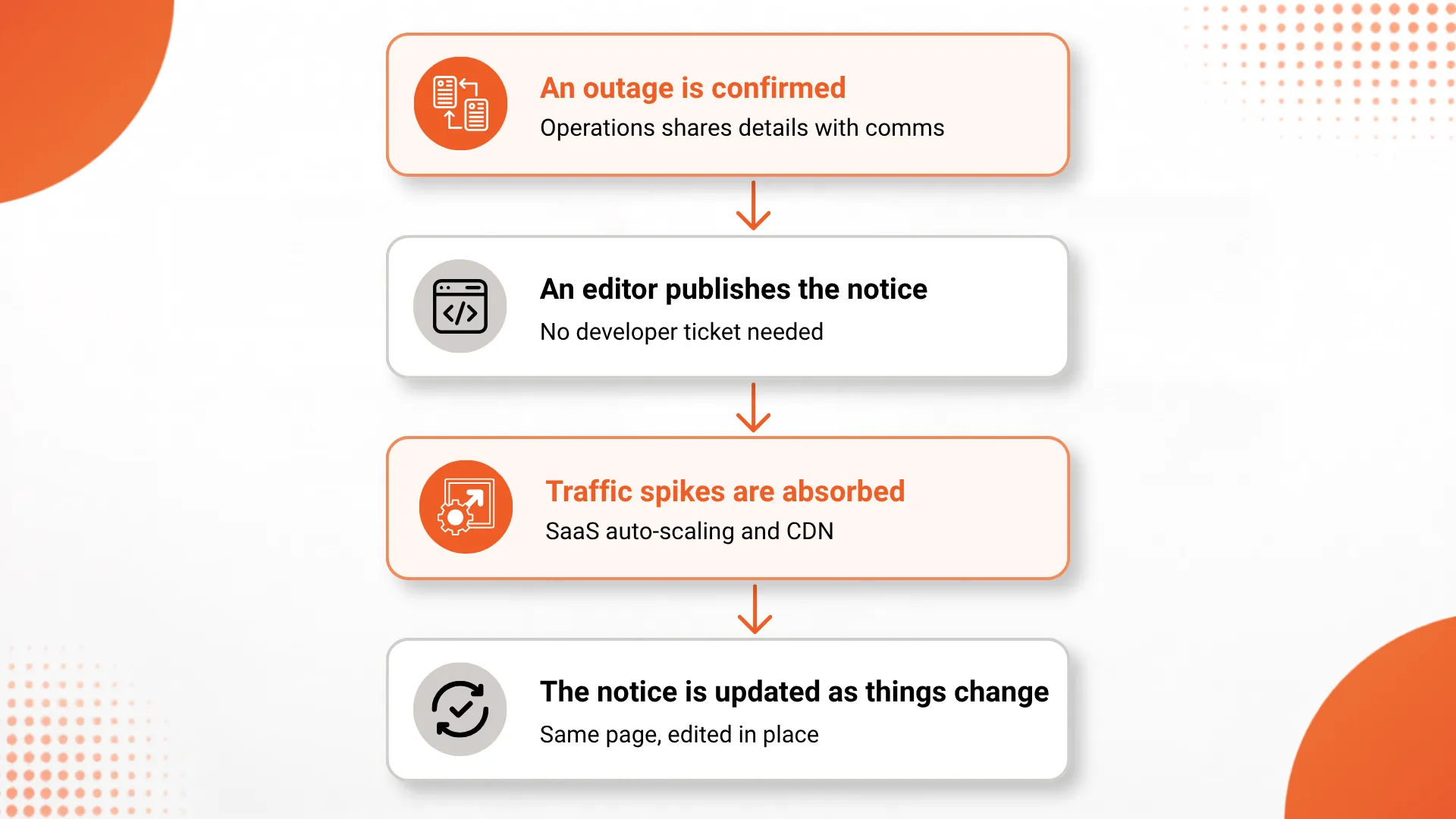
Operations confirms the fault and shares the details with the communications team, who own the customer message.
The editor writes and publishes the notice directly in the platform. No developer ticket is needed for routine content work.
On the SaaS offering, auto-scaling and the content delivery network help the site keep serving pages while visitor numbers climb.
As restoration estimates change, the editor updates the same page in place, so customers always see one current source of truth.
Worth calling out specifically: showing a live outage map or a customer's own outage status on the website is not a switch inside the platform. It requires a connection to the utility's outage management system, built through Xperience by Kentico's .NET API or its GraphQL headless API. The platform provides the place to display and manage that content, and a clean way to integrate. The data feed, its accuracy, and its security remain the responsibility of the integration work. Kentico's own guidance is to define the system of record first, then sync through APIs, which is the right order of decisions for any utility project.
| Aspect | Typical Legacy Utility Site | Xperience by Kentico |
|---|---|---|
| Tariff and notice updates | Developer or agency dependent | Editors publish directly |
| Outage day scaling | Sized for average traffic | SaaS auto-scaling and content delivery network |
| Security certifications | Varies by platform and add-ons | ISO 27001 and SOC 2 Type 2 stated by Kentico |
| Access and audit controls | Often limited or plugin based | Role based access controls and audit trails |
| CRM connection | Custom, one off | Out of the box Salesforce and Microsoft Dynamics |
| Billing and outage systems | Custom integration | Custom integration through open APIs |
Editors Publish Without Waiting. Communications and marketing teams can change tariff pages and outage notices themselves, which matters most when timing is tight.
Security Claims Are Specific. Kentico names ISO 27001 and SOC 2 Type 2, plus specific controls such as role based access and audit trails, which gives a security team concrete items to verify instead of general assurances.
A Clear Scaling Story on SaaS. Auto-scaling, a content delivery network, and a stated 99.9 percent uptime design target give a utility a documented starting point for peak demand planning.
Open APIs Keep Options Open. Because the platform exposes a .NET API and a GraphQL headless API, a utility can connect its own back office systems without waiting for a vendor to build a connector.
Energy and Utilities Is Not a Dedicated Vertical. Kentico lists the sector among other industries it serves and does not publish a dedicated industry page for it. Providers should ask for relevant references instead of assuming sector specific features exist.
Billing and Account Integrations Are Custom Work. No prebuilt connectors are listed for utility billing or customer information systems, so budget and timeline should reflect real integration development.
SaaS Scaling Does Not Replace Load Testing. A documented uptime target is not proof that a specific site will hold on the worst storm day. A utility should test its own templates and integrations under realistic peak load.
Compliance Is Shared Responsibility. Platform certifications help, but a utility still owns its content accuracy, its integration security, and its own regulatory obligations.
The Biggest Risk May Be an Old Version. Many utilities run long lived systems. Kentico Xperience 13 reaches end of support on December 31, 2026, after which it receives no fixes or security patches. For a regulated provider, running unsupported software is a governance question as much as a technical one.
Migration Is a Rebuild, Not a Click. Xperience by Kentico is a rebuild on modern .NET, so moving from version 13 is a planned project. Kentico provides an official migration toolkit for content, and our guide to upgrading from Kentico Xperience 13 covers how that work is usually staged.
Editing Speed Can Matter More Than Features. For utilities, the most valuable capability is often the simplest: letting the right person publish an accurate notice in minutes, without opening a technical request.
Xperience by Kentico is a credible fit for an energy or utility provider that wants editors in control of tariff and outage content, a documented security and uptime posture, and open APIs for the systems behind the website. It is not a ready made utility product. The sector is not one of Kentico's dedicated verticals, and the most important integrations, billing, accounts, and outage data, are custom work.
That honesty is useful for planning. A utility that budgets for integration, load tests its outage pages, and treats compliance as a shared responsibility will get far more from the platform than one expecting a turnkey solution.
If your team is weighing this decision, or still running Kentico 13 with the December 31, 2026 deadline approaching, start by listing the three or four customer moments that matter most, such as outage updates or tariff changes, and test the platform against those specific moments first.
Kentico lists energy and utilities among the industries it serves, but it does not publish a dedicated industry page for the sector the way it does for healthcare or manufacturing. The platform's general capabilities apply, including content management, personalization, security certifications, and open APIs, while sector specific features such as billing connectors need custom development.
Xperience by Kentico's SaaS offering uses horizontal auto-scaling and a content delivery network, and it is designed for 99.9 percent uptime. A utility should still load test its own pages and plan for peak demand, since outage traffic can far exceed normal volumes.
Kentico lists out of the box CRM integrations for Salesforce and Microsoft Dynamics, plus an open .NET API and a GraphQL headless API for custom work. It does not list prebuilt connectors for utility billing or customer information systems, so those integrations are typically built as custom development.
Kentico states that the platform is built on ISO 27001 and SOC 2 Type 2 standards and includes role based access controls, encryption, audit trails, and consent tools. A utility should still validate the platform against its own regulatory and internal security requirements before committing.
Kentico Xperience 13 reaches end of support on December 31, 2026, after which it no longer receives security patches or fixes. A utility on Kentico 13 should plan a migration to Xperience by Kentico, which is a rebuild on modern .NET rather than a one click upgrade, and Kentico provides an official migration toolkit to carry content across.

With more than a decade of experience in designing and developing enterprise-grade applications, Manoj brings deep technical expertise and a solution-driven approach to software development. Specializing in modern technologies, cloud-native architectures, AI-powered applications, and system integrations, Manoj leads development teams in delivering secure, scalable, and business-focused solutions. Committed to engineering excellence and innovation, Manoj enjoys solving complex technical challenges while helping organizations accelerate their digital transformation journey.
Follow on LinkedIn