

.png)
AI in Retail: Personalization Meets Demand Forecasting
TL;DR: Retail AI splits into two connected disciplines: personalization, which tailors recommendations, search results, and offers to an individual shopper, and demand forecasting, which predicts how much of each product will sell where and when. Retailers that connect the two see the clearest results, since a personalization engine can only promise what an accurate forecast says will actually be in stock. The same shopper data that powers good recommendations, handled carelessly, is exactly what turned Target's pregnancy-prediction program into a national privacy story back in 2012, a lesson every retailer building on this data still has to account for.
This article covers why personalization and forecasting built in separate silos create real business problems, the core building blocks of a connected retail AI stack, a side-by-side look at replacing manual planning with an AI-driven approach, and the trade-offs to expect once a system goes live. The upside is well documented: McKinsey's research on retail personalization found that targeted recommendations and triggered communications typically lift revenue by 5 to 15 percent, with marketing spend efficiency improving by 10 to 30 percent on top of that.
The Problem With Personalization and Forecasting Built in Isolation
Most retailers already run some form of personalization and some form of demand planning. The trouble starts when the two systems do not talk to each other:
- Recommending items that are not actually available. A personalization engine that only checks a warehouse's total stock count, not what is already reserved or in transit, will keep recommending and promoting products a customer cannot actually receive on time.
- Forecasts built on stale patterns. A model trained only on last year's sales has no way to react to a new trend, a viral product, or a shift in local demand until weeks after the pattern has already changed.
- Privacy backlash from over-personalization. When a system infers something a customer never chose to share, such as a pregnancy, and acts on it through obvious targeted marketing, the resulting backlash can outweigh any revenue gain. Target's own pregnancy-prediction program remains the reference case for this risk.
- One-size-fits-all promotions. A national campaign built from national-level demand data ignores real differences between regions, climates, and local events, so it under-serves some stores and overstocks others.
- Disconnected teams, disconnected data. Marketing usually owns personalization and supply chain usually owns forecasting. Without a shared data layer, each team optimizes its own numbers while working from a different picture of reality.
The Core Idea: One Data Layer, Two Connected Engines
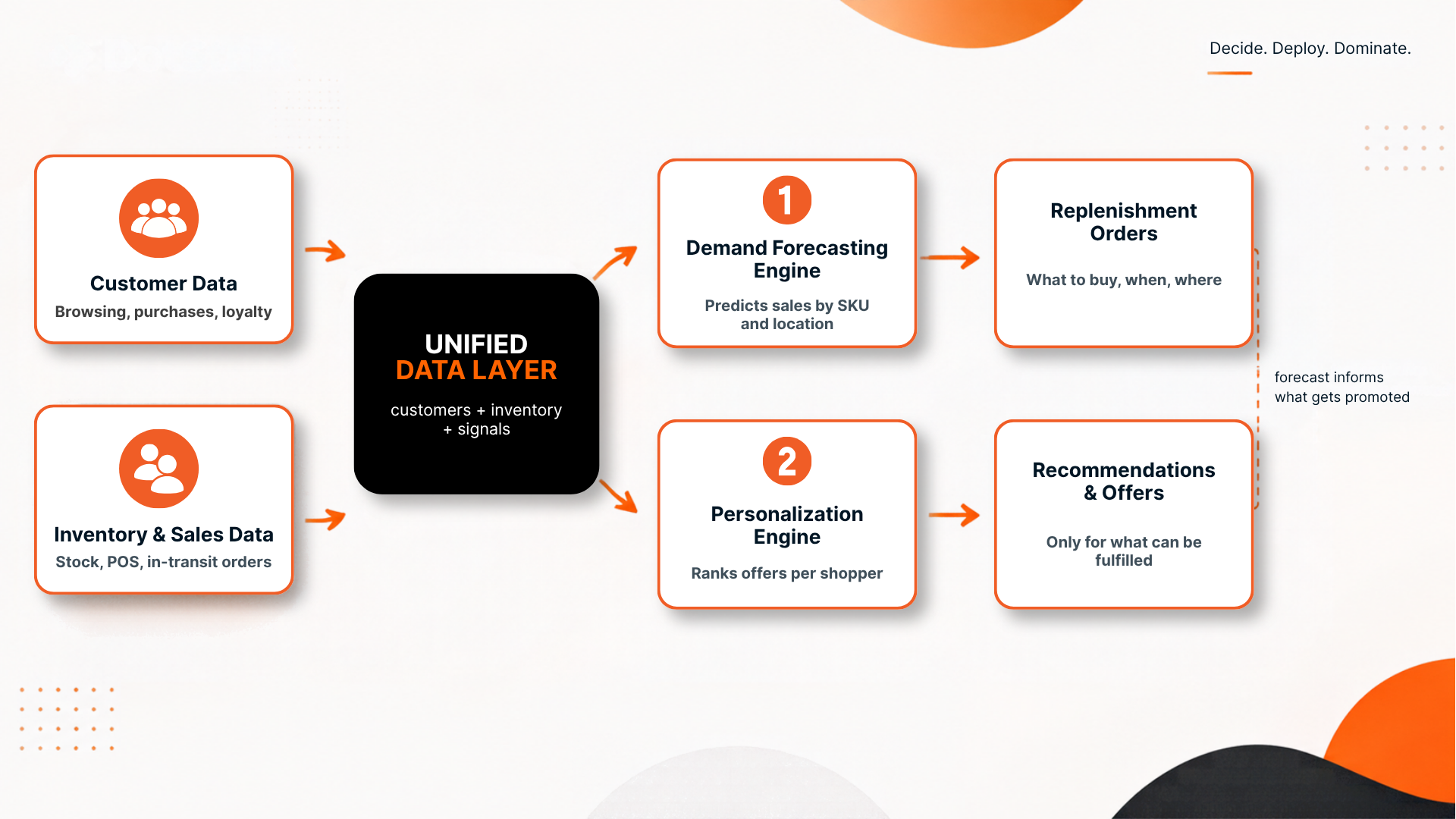
A modern retail AI stack treats personalization and forecasting as two outputs of the same underlying data, not two separate projects. The flow looks like this:
.png "int-a-(1).png")
A single customer and inventory data layer. Both engines read from the same source of truth for stock, orders, and customer behavior, instead of each team maintaining its own partial copy of the data.
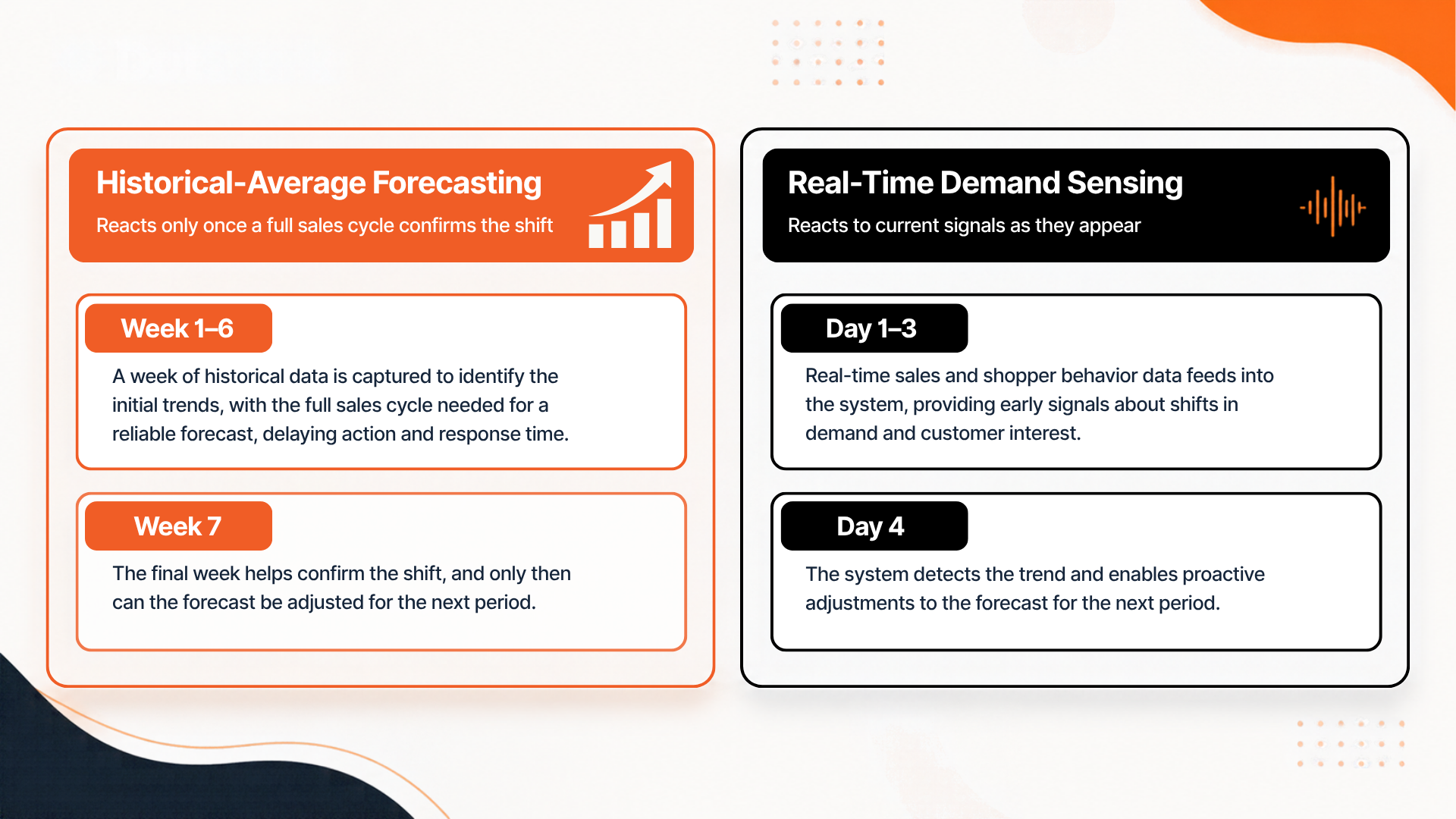
Demand sensing, not just historical averages. Demand sensing blends recent point-of-sale data with external signals such as weather, local events, and search trends, so the model reacts to what is happening now rather than only what happened last quarter.
.png "int-b-(1).png")
Hybrid recommendation models. Collaborative filtering (what similar customers bought) paired with content-based signals (what this specific product is like) covers both popular items and new or niche products that do not yet have much purchase history.
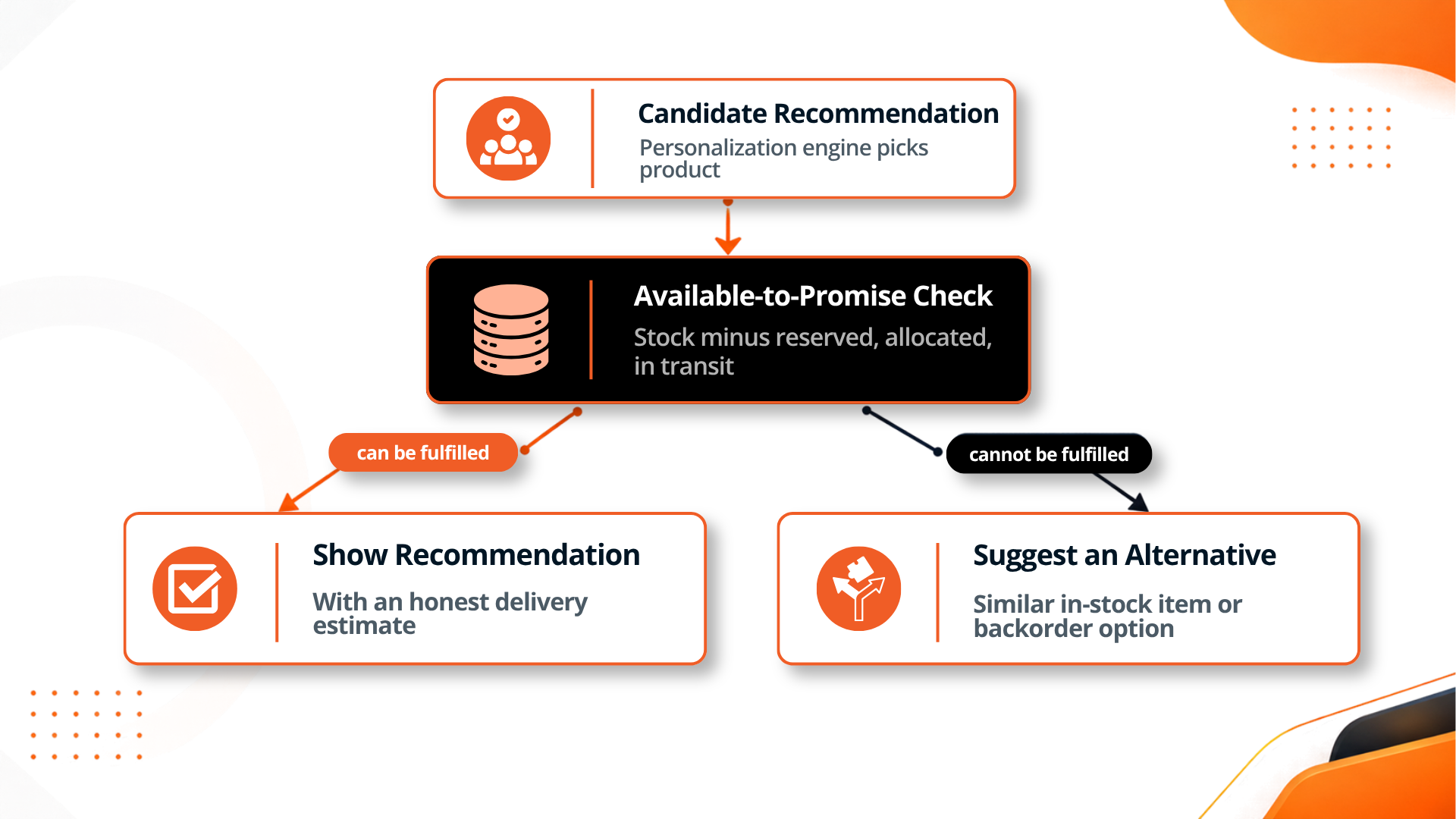
Available-to-promise checks before every recommendation. A recommendation is only useful if the item can actually reach the customer in a reasonable time, which is why the personalization layer needs to query real inventory commitments, not a static stock count.
Human review on pricing and sensitive segments. Fully automated dynamic pricing and highly targeted campaigns benefit from a human check before launch, particularly for promotions that could be read as invasive if a customer noticed the targeting.
A closed feedback loop. Forecast accuracy and actual sell-through get fed back into both engines, so a forecast that is consistently wrong for a category gets corrected instead of quietly repeating the same error every season.
Two Journeys: Planning for a Seasonal Product Launch
Journey A: The Traditional Approach (Manual Planning)
Step 1: Build a forecast from spreadsheets. A planner extrapolates from last year's sales in a spreadsheet, adjusting manually for a rough sense of "growth" with no systematic way to factor in this year's trends.
Step 2: Segment customers into broad buckets. Marketing splits the customer list into a handful of static segments, such as "frequent buyers" or "lapsed customers," and sends the same campaign to everyone in each bucket.
Step 3: Set safety stock and wait. Inventory buffers are set once at the start of the season based on the spreadsheet forecast and rarely adjusted until the numbers come in.
Step 4: Run the post-mortem after the damage is done. Once the season ends, the team reviews what sold and what didn't, applies the lessons to next year's spreadsheet, and repeats the same lag next season.
Journey B: The AI-Driven Approach
Step 1: Feed real-time signals into the forecast. The demand forecasting model ingests current sell-through, regional trends, and external signals continuously, rather than freezing a single forecast at the start of the season.
Step 2: Personalize at the individual level, within inventory limits. The recommendation engine ranks offers per shopper but filters out anything the available-to-promise check flags as unfulfillable.
Step 3: Adjust replenishment automatically. As actual sales diverge from the forecast, purchase and replenishment orders adjust within pre-set guardrails instead of waiting for a scheduled review.
Step 4: Monitor and retrain continuously. Forecast error and recommendation performance are tracked as ongoing metrics, and the models are retrained on a regular cadence rather than once a year.
Implementation Detail: Filter by Available-to-Promise, Not Raw Stock Count
A detail that separates a working system from a frustrating one: the personalization engine should never recommend a product based on the warehouse's total stock count alone. Available-to-promise (ATP) logic subtracts what is already reserved for other orders, allocated to other channels, or in transit but not yet received, leaving only what can genuinely be committed to a new customer. Skip this step and a retailer ends up recommending items that show as "in stock" in the system but are actually spoken for, which produces the exact experience personalization was supposed to prevent: an order that gets cancelled or delayed after the customer was told it was available. Building this check requires the personalization engine to query the same live inventory layer the forecasting engine uses, which is one reason retailers often bring in dedicated AI agent development support to build and monitor the automated checks that sit between the two systems, rather than trying to bolt the logic onto an existing recommendation tool as an afterthought. The check itself is a simple gate that sits between the two engines:
.png "int-c-(1).png")
Traditional Retail Planning vs. AI-Driven Retail Stack
| Dimension | Traditional Planning | AI-Driven Stack |
|---|---|---|
| Forecast inputs | Last year's sales, manual adjustments | Real-time sales, weather, events, search trends |
| Personalization granularity | Broad static segments | Individual shopper, updated continuously |
| Link between forecasting and personalization | None; separate teams and tools | Shared data layer with live inventory checks |
| Response to a demand shift | Next scheduled review, often weeks later | Near-continuous, within set guardrails |
| Main risk | Stockouts, overstock, generic offers | Over-personalization and privacy backlash if unchecked |
| Best fit | Small catalogs, stable, predictable demand | Large catalogs, seasonal or volatile demand |
What's Working Well
Demand sensing catches shifts early. Blending point-of-sale data with external signals lets retailers react to a trend within days instead of waiting for a full sales cycle to confirm it.
Hybrid recommendations cover the long tail. Pairing collaborative filtering with content-based matching means new or niche products can still be recommended sensibly before they have enough purchase history of their own.
Available-to-promise checks build trust. Customers who consistently get recommendations that turn out to be genuinely available are more likely to trust the next recommendation, which compounds over time.
Honest Trade-offs
The cold-start problem never fully goes away. New customers with no history and new products with no sales data are genuinely hard to personalize or forecast well, no matter how good the model is for established items and shoppers.
Personalization has a comfort ceiling. There is a real point past which more personalization stops feeling helpful and starts feeling like surveillance. Retailers rarely find that line through modeling alone; it usually takes direct customer feedback and a willingness to pull back.
Forecasting still struggles with genuine novelty. A model trained on historical patterns has little to say about a true demand shock, such as a sudden viral moment or a supply disruption, until new data starts to accumulate.
Surprising Decisions Worth Noting
Forecasting at the category level sometimes beats forecasting at the SKU level. For long-tail products with thin, noisy sales history, grouping similar SKUs into a cluster and forecasting the cluster, then splitting the result back down, often produces a more stable number than trying to forecast each SKU in isolation.
Fewer, better recommendations can outperform more of them. Some retailers find that showing three well-matched recommendations converts better than showing ten, because a shopper presented with too many personalized suggestions at once starts to distrust the whole list.
The Target case is still the standard internal test. Several retail data teams now run new personalization features through an informal check: would this look acceptable if the customer saw exactly which signals triggered it? That question traces directly back to the backlash from Target's pregnancy-prediction program.
The End Result
Personalization and demand forecasting are often sold as separate product categories, but the retailers getting the most value treat them as one system built on one data layer. A forecast that is not connected to personalization keeps recommending items it cannot actually deliver. Personalization that is not grounded in real inventory and real customer consent creates the exact experience, and occasionally the exact backlash, that undermines the investment. Retailers evaluating where to start typically benefit from an AI strategy consulting engagement that maps which use case, personalization or forecasting, will move the numbers first, rather than building both at once and hoping they connect later.
Frequently Asked Questions
What is the difference between AI personalization and AI demand forecasting in retail?
AI personalization uses a shopper's browsing and purchase history to tailor what they see, such as product recommendations, search ranking, and offers. AI demand forecasting uses historical sales, seasonality, and external signals to predict how much of each product will sell at each location over a given period. Personalization decides what to show one customer; forecasting decides how much stock to have ready for all customers. The two work best when connected, since a recommendation is only useful if the recommended item is actually available.
How much can AI actually improve retail demand forecasting accuracy?
Research from McKinsey on supply chain analytics found that AI-driven forecasting can reduce forecast errors by 20 to 50 percent compared with traditional statistical methods, which in turn can cut lost sales from stockouts significantly. The exact improvement depends on data quality, how volatile demand is for a given product, and how frequently the model is retrained. Fast-moving, high-volume products with clean sales history tend to see the larger gains; low-volume or brand-new products see smaller gains until enough data accumulates.
Why did Target's AI-driven personalization become a cautionary tale?
In 2012, journalist Charles Duhigg reported in The New York Times Magazine that Target had built a statistical model to identify likely pregnant shoppers from purchase patterns, so it could market baby products to them early. The model was accurate enough that a teenager's father learned about her pregnancy from mailed coupons before she had told him. The technique itself worked, but the public reaction showed that predicting something a customer has not chosen to share, even correctly, can cause real harm and reputational damage. It remains a standard example of personalization outrunning customer comfort.
Can small or mid-size retailers realistically use AI demand forecasting?
Yes. Cloud-based forecasting tools and managed machine learning platforms have made AI-driven forecasting accessible without an in-house data science team, and the cost has dropped substantially over the past few years. Smaller retailers typically start with their highest-volume, most predictable product lines rather than trying to forecast every SKU at once, which keeps data requirements and setup cost manageable while still delivering a measurable reduction in stockouts and overstock.
Does AI personalization increase the risk of a privacy backlash?
It can, if the system infers and acts on sensitive information the customer never explicitly shared, or if personalization feels like surveillance rather than convenience. The risk is highest when a system predicts a private life event, such as a pregnancy or a health condition, and reveals that inference through obvious targeted marketing. Retailers reduce this risk by limiting which inferences a model is allowed to act on, testing campaigns for how they would look if a customer noticed the targeting, and giving customers visibility and control over their own data.
Ready to Connect Your Personalization and Forecasting Data?
Most retailers already have the raw data to run both personalization and demand forecasting well. What's usually missing is the connective layer between them, and the discipline to keep personalization inside what the business can actually deliver. DotStark builds that layer, from generative AI solutions for personalized product content and messaging to the forecasting and inventory logic behind it. If you're weighing where to start, or want an outside read on whether your current setup is creating the kind of mismatch this article describes, talk to our team about your retail data and where the fastest win is likely to be.
.png "cta-(3).png")

.png)